Open Source AI's Biggest Model Can't Run on Your Hardware
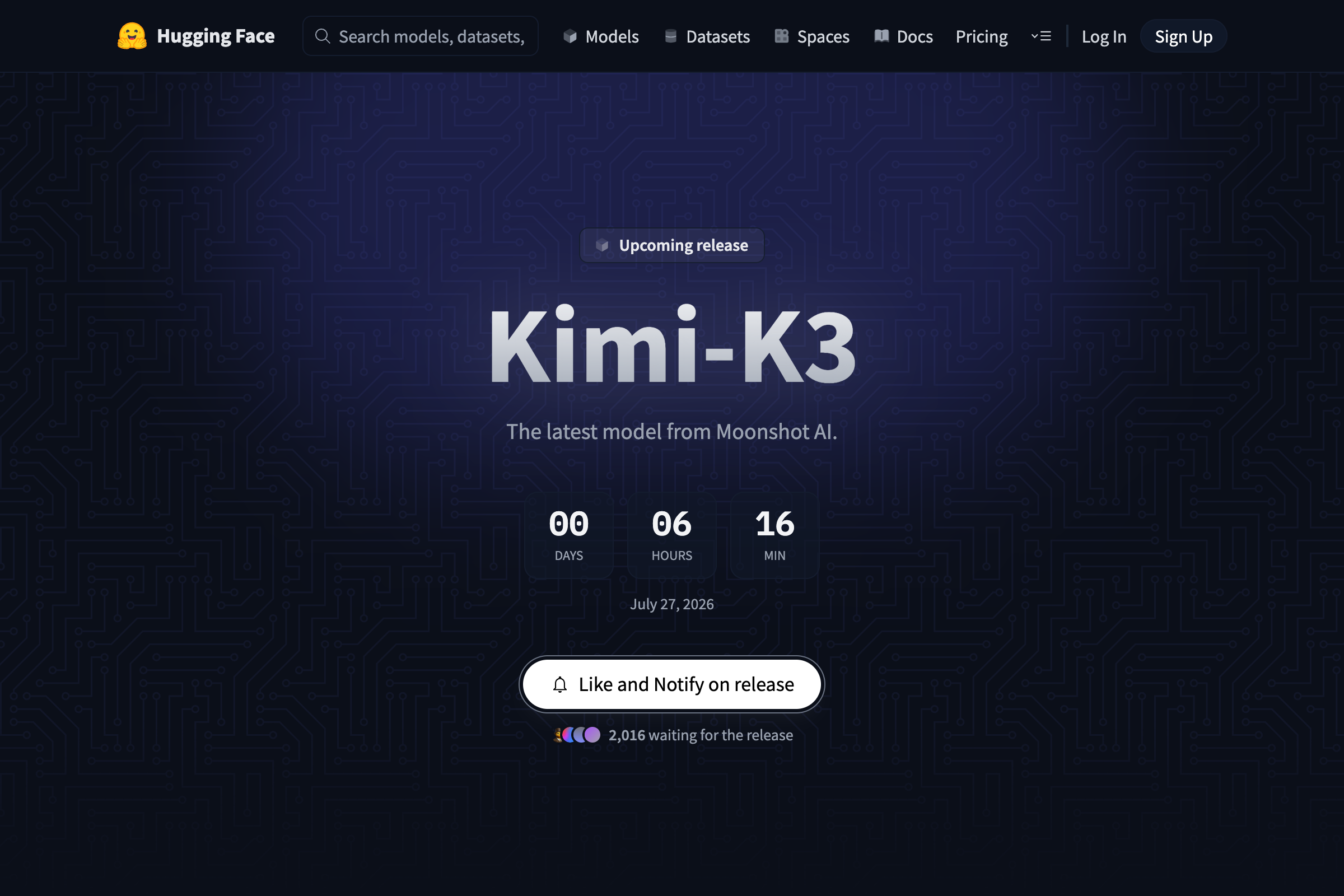
Kimi K3's weights land on Hugging Face today. As I write this, the model page is a countdown, a few hours to go, with thousands watching: 2.8 trillion parameters, the first open model in the 3-trillion class, from Moonshot AI.[1] The anticipation has a familiar shape: the frontier goes free today. Download it, self-host it, escape the API.
Then read the system requirements.
Can you self-host Kimi K3?
No, not realistically. The four-bit version of K3 needs roughly 1.4 terabytes of fast memory resident before it processes a single token; at full 16-bit precision, about 5.6 terabytes. That translates to around eighteen 80GB accelerators, or one node of the newest eight-card, 192GB-per-card silicon.[2]
For scale: a seriously loaded workstation tops out around 0.1 to 0.2 terabytes of usable fast memory. The gap is not a gap you upgrade across. It is a category difference.
So who can actually run it? Inference providers, large enterprises, and clouds running racks of the newest silicon. Not you, not a startup's on-prem box, not the loaded Mac Studio the self-hosting dream lives on.
The license democratizes ownership on paper while the hardware recentralizes who can actually exercise it.
You can hold the weights. You cannot lift them. Both are true at once, and neither cancels the other.
(One honesty note as of publish day: Moonshot has said the license terms land with the release itself, so check them before you build on the assumption of unrestricted commercial use.[2])
What does "open weights" actually mean at frontier scale?
It means you can inspect the model, fine-tune it, and, critically, run it without your data flowing to its maker. It does not mean you can run it yourself. At 3-trillion scale, "open" describes who may use the model, not who can physically host it.
This is not a knock on K3, and it is not an argument that open weights are hollow. It is a clarification the celebration keeps skipping: the self-hosting dream, a frontier model on hardware you own, has a hard ceiling, and the biggest open release ever is standing on it.
But two freedoms survive the hardware wall intact, and they are the ones worth buying:
- Data control. Because the weights are open, you, or a hosting provider you choose and trust, can run K3 without your prompts and code ever touching Moonshot's servers. For a model whose maker's API is hosted in another jurisdiction, that is the whole game.
- Provider portability. The same weights can run anywhere with the capacity. Multiple hosts will serve K3, which means you can move your workload to whoever is cheapest and play providers against each other. That leverage simply does not exist with a proprietary model, where the vendor owns the exit.
Notice what both freedoms are: structural leverage on price, terms, and data. And what they are not: independence from infrastructure. At 1.4 terabytes, someone is always hosting this for you. Open weights let you choose who, and walk when they misbehave.
Is open-source AI actually cheaper if you can't self-host it?
Often yes, but the saving comes from competition, not from free compute. You will not run K3 on hardware you already own; as the Techi analysis puts it, at this scale "the megawatts go mostly toward keeping 1.4 terabytes warm."[2] The saving is that many hosts can serve the same weights, and rivals bid the price down.
That is the same discipline we mapped in the open-source portability playbook: the 6x cost advantage is real, but it is captured through providers, not garages. K3 sharpens that playbook's point to its extreme. At frontier scale, portability is not a hedge around self-hosting. Portability is the entire prize.
It also connects to why AI prices keep getting repriced: an open model's price is set by a market of hosts competing on inference economics, while a closed model's price is set by one vendor's spreadsheet. Structurally, only one of those bends in your favor over time.
What should a builder actually do with this?
Plan for provider choice, not a server rack. If K3-class capability matters to you, the playbook is short:
- Choose open weights for the leverage, not the romance. Data control and price competition are the real goods; self-hosting was never on the table at this scale.
- Run it through the cheapest trustworthy host, and keep your integration portable enough to move when a cheaper one appears.
- Skip the independence budget. Do not spec the on-prem cluster; spend that attention on exit-readiness instead.
One boundary on the claim: this is today's wall, not a law of nature. Hardware improves, quantization improves, and a distilled K3-class model that fits a workstation would move the line. The structural point survives the specifics: whenever the frontier is this heavy, openness delivers choice, not independence.
The biggest open model ever ships today, and the story is not that you can run it. It is that you can't, and that this is fine once you know what open weights are for.
They keep the model layer a competitive market, they hand you data control, and they guarantee you an exit.
That is a smaller promise than "own your AI." It is also the one that is actually true.
References
Frequently asked
Can you self-host Kimi K3?›Not on anything most teams own. 4 terabytes of fast memory resident before it processes a single token, which translates to roughly eighteen 80GB accelerators or a full node of eight 192GB cards.
What does 'open weights' actually mean at frontier scale?›It means you can inspect, fine-tune, and deploy the model, and critically that your data does not have to flow to the model's maker.
Is open-source AI actually cheaper if you can't self-host it?›Often yes, but for a different reason than people assume. 4 terabytes of weights warm in memory.
So what freedom do open weights at this scale really give you?›Two things that matter. First, data control: you, or a provider you trust, can run the model without sending your prompts and code to the model's maker.
Does the biggest open model being un-runnable make open weights pointless?›No, it just clarifies what they are for. Open weights were never mainly about hobbyists running frontier models at home; that was always going to be gated by hardware.
Let’s build it together.
We turn clever prototypes into production systems people can rely on. If you’re building with agents and want a hand making it real, leave your email and we’ll be in touch.