The AI Bubble Is a Pricing Problem, Not a Timing Problem
On July 14, the Bank for International Settlements, the institution central banks answer to, warned that the AI build-out ranks among the largest investment booms in US history, and that its reliance on debt and circular financing makes a bust more likely.[1] It hit the Hacker News front page the same day.
The conversation it started, like almost all AI bubble talk, is aimed at investors: will it pop, when, and how should I position.
If you build software on top of AI, that is the wrong question for you. The bubble is not a timing problem you need to predict. It is a pricing problem you can already see, because the token prices you architect against are subsidized, and the subsidy is structural.
Will the AI bubble pop?
Nobody can time it, and for a builder that is the point, not a disappointment. A strategy that depends on guessing the timing right is not a strategy. What you can know is the shape of the pressure on the prices you pay, and that is visible now, on the balance sheets.
The BIS was blunt about the risk. It placed this boom in a specific historical company, and warned that scale plus debt is what turns a boom into a bust.
Larger booms end in more disruptive busts. The race to commit investment early to gain a head start also increases vulnerability and raises the likelihood of a bust.
Read that as a builder, not a trader. It is not telling you when to sell. It is telling you that the input under your product is propped up by something fragile.
Why are AI tokens so cheap right now?
Because you are not paying the real cost. Frontier vendors price inference against a future of enormous scale, and that future is currently financed rather than earned.
The BIS documented the gap. The five largest hyperscalers are on track to spend over $1 trillion on AI capex across 2025 and 2026, and those commitments are outpacing their earnings and free cash flow, so some are turning to debt to cover the difference.[2]
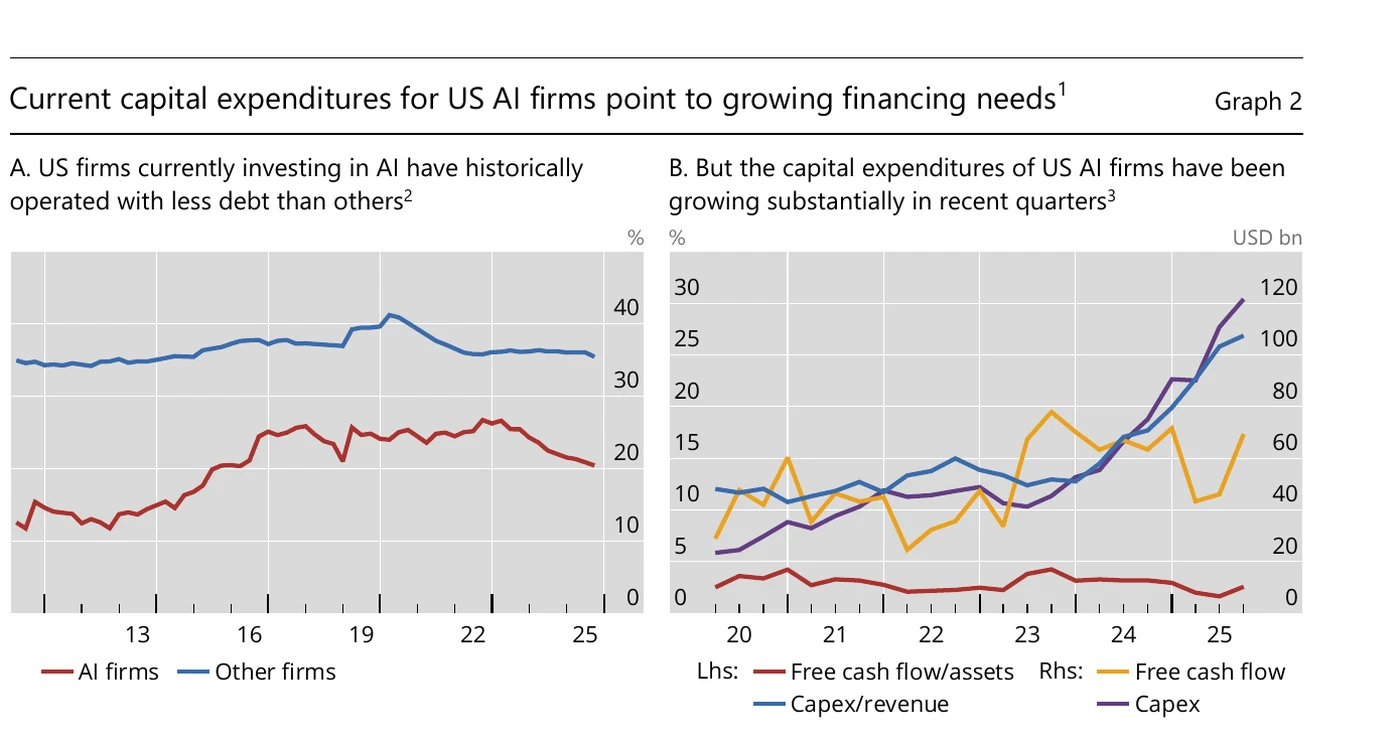
The margin that is supposed to service that debt is compressing from below. Independent analysis by the engineer Martin Alderson estimated frontier inference has run around 90% gross margins.
Meanwhile the open-weight model GLM 5.2 now delivers frontier-adjacent agentic coding at roughly $4.40 per million tokens, about 15 to 20 percent of frontier pricing, with near-zero cost to switch because it speaks the same API. The frontier's capability lead, once measured in years, is now measured in weeks.
So two forces press on the same price from opposite sides: debt service demands revenue from above, and open-weight commoditization undercuts margins from below. Today's token price is an artifact of that financing structure. It is not a cost structure, and it is not a settled feature of the technology.
What happens to AI API prices if the bubble bursts?
Prices go up, and here is the part the timing debate misses: they go up whether the bubble bursts or not. This is a fork that isn't really a fork, because both paths lead to the same place for the prices you pay.
If it bursts, you get consolidation, vendors dying, and price floors as survivors stop selling inference below cost on investor capital. If the boom simply continues, margin discipline arrives anyway, through metering, usage caps, and repricing.
We watched the first moves of that already: the metered-billing cutover we documented in July, Anthropic's price raises, and large employers openly discussing per-engineer token budgets. Both branches end the era of flat, cheap, all-you-can-eat tokens.
Demand is drifting up underneath all of this regardless. Across thousands of businesses, token usage grew about 1,001% from January 2025 to April 2026 while dollar spend grew 497%, even as the price per token fell.
Your AI bill was climbing before any repricing arrives, because usage drift raises the bill even at flat prices. The reprice lands on top of a number that is already moving.
Who actually pays when the subsidy ends?
Not everyone, and not evenly. Price moves in this market have never been uniform[3], and this reprice is no exception: it is a transfer, not a tide. The metered commodity you can shop for keeps getting cheaper; the bundled seat you settled into is where the increase collects.
- API users. The commodity token keeps getting cheaper[4], and the open-weight models behind it now sit within a point or two of the frontier[5], rentable by the token on Bedrock and a dozen other endpoints. If you buy raw, metered tokens and can switch, competition is on your side, not against you.
- Subscription users. The increase lands here, on subscriptions, seats, and overages, where a vendor can meter you, cap you, and bill the overflow, because this is where switching is stickiest. Anthropic drew the line in plain sight, keeping interactive plans flat while routing programmatic usage into a credit pool that bills at API rates past the cap.
We traced that split when the prices moved, and the two trajectories were visible a month earlier: API pricing drifting toward true cost, subscription pricing propped up for a correction.
How does the AI bubble compare to past bubbles?
The BIS drew the lineage itself, and it is not flattering: canal mania in the 1830s, the British railway mania of the 1840s, the electrification boom of the late 1920s, and the dot-com crash of 2000. Each paired a real breakthrough with more capital than returns could justify, and each ended in a recession.
The detail worth carrying is not that booms bust. It is who walked out the other side.
The survivors were not the firms that timed the top. They were the ones whose economics did not require the mania to continue. A railway that made money at normal traffic outlived the ones that only worked if the frenzy did. The lesson is architectural, not predictive.
How do I protect my product from AI price increases?
Start with the question this whole post has been building toward: how much of your cost, and your own development, rides on a subscription you cannot shop versus metered tokens you can? Size that exposure first, then close it while it is cheap. Three moves carry most of the resilience:
- Model portability. Build against compatible endpoints instead of hard-wiring one frontier model, keep a tested fallback ready, and treat the model as a swappable component. Hard-wiring one model into product-critical paths is the lock-in failure we wrote about, and it is the expensive one to unwind under a reprice.
- Cost observability. Track tokens per user action as a first-class product metric with alerts, not a line you discover on a monthly invoice. You cannot manage a variance you do not measure.
- Margin-aware design. Know your per-action unit cost, know what you can pass through to customers, and run the number: if a 3x input reprice would kill the product, that is a design flaw you can fix today, not a market event you have to fear.
None of this is a reason to stop building on AI, and it is not a market call. We build on these platforms every day and intend to keep doing it. The point is narrower: the cheap token is the least stable input in your stack, and resilience to its repricing is cheap to buy now.
The builders who come through this will not be the ones who guessed when the bubble popped. They will be the ones whose margins survived the answer either way. The question worth your time is not when it pops. It is which of your margins survive a reprice.
References
- ^
- ^2.Bank for International Settlements, “Financing the AI Boom: From Cash Flows to Debt (Bulletin No. 120)” (January 2026)
- ^
- ^4.Andreessen Horowitz (Guido Appenzeller), “Welcome to LLMflation: LLM inference cost is going down fast” (November 2024)
- ^
Frequently asked
Will the AI bubble pop?›Nobody can time it, and that is the point. The Bank for International Settlements warned in July 2026 that the race to commit early through debt and circular financing makes a bust more likely, but its real message for builders is about variance, not timing.
Why are AI tokens so cheap right now?›Because you are not paying the real cost. Frontier vendors price inference against a future of scale currently funded by over $1 trillion in capex that outpaces their earnings and free cash flow, per the BIS.
Which AI prices are actually going up?›Not the raw, metered API token, which keeps falling as open-weight models reach near-parity on coding and competition drives price-per-token toward true compute cost.
What happens to AI API prices if the bubble bursts?›A bust means consolidation, vendor mortality, and price floors as surviving vendors stop subsidizing inference with investor capital and debt.
How does the AI bubble compare to past bubbles?›The BIS itself draws the lineage: canal mania in the 1830s, the British railway mania in the 1840s, the electrification boom of the late 1920s, and the dot-com crash of 2000.
How do I protect my product from AI price increases?›Three moves: model portability (keep switching costs near zero by building against compatible endpoints instead of hard-wiring one frontier model), cost observability (track tokens per user action as a first-class product metric, not a monthly surprise), and margin-aware design (know your per-action unit cost and what you can pass through).
Let’s build it together.
We turn clever prototypes into production systems people can rely on. If you’re building with agents and want a hand making it real, leave your email and we’ll be in touch.