Anthropic just raised the prices. Here's what it actually means.
A LinkedIn post crossed my feed yesterday from Nick Haroldsen, voicing what a lot of developers are voicing right now: Claude Code is about to cost 10x more. They got people hooked, now they're racking up the prices.
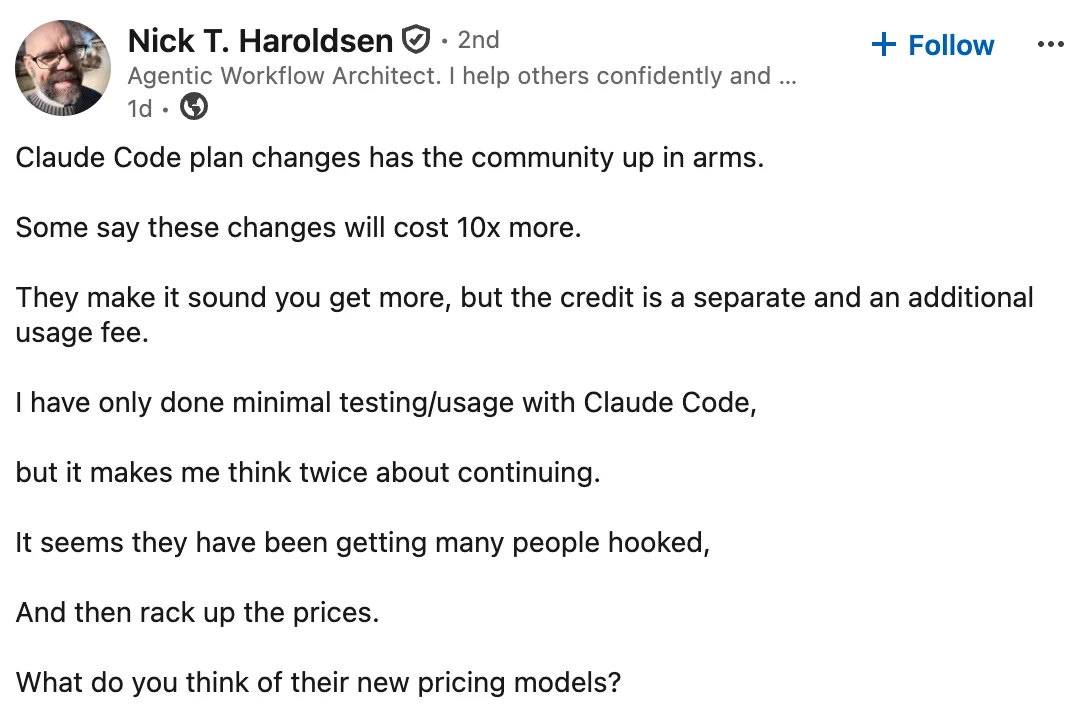
The diagnosis is partly right. The framing is mostly wrong. The difference matters, because what Anthropic actually did is more interesting than a price hike, and it's exactly the move that our last post predicted two days before the announcement.
What Anthropic actually announced
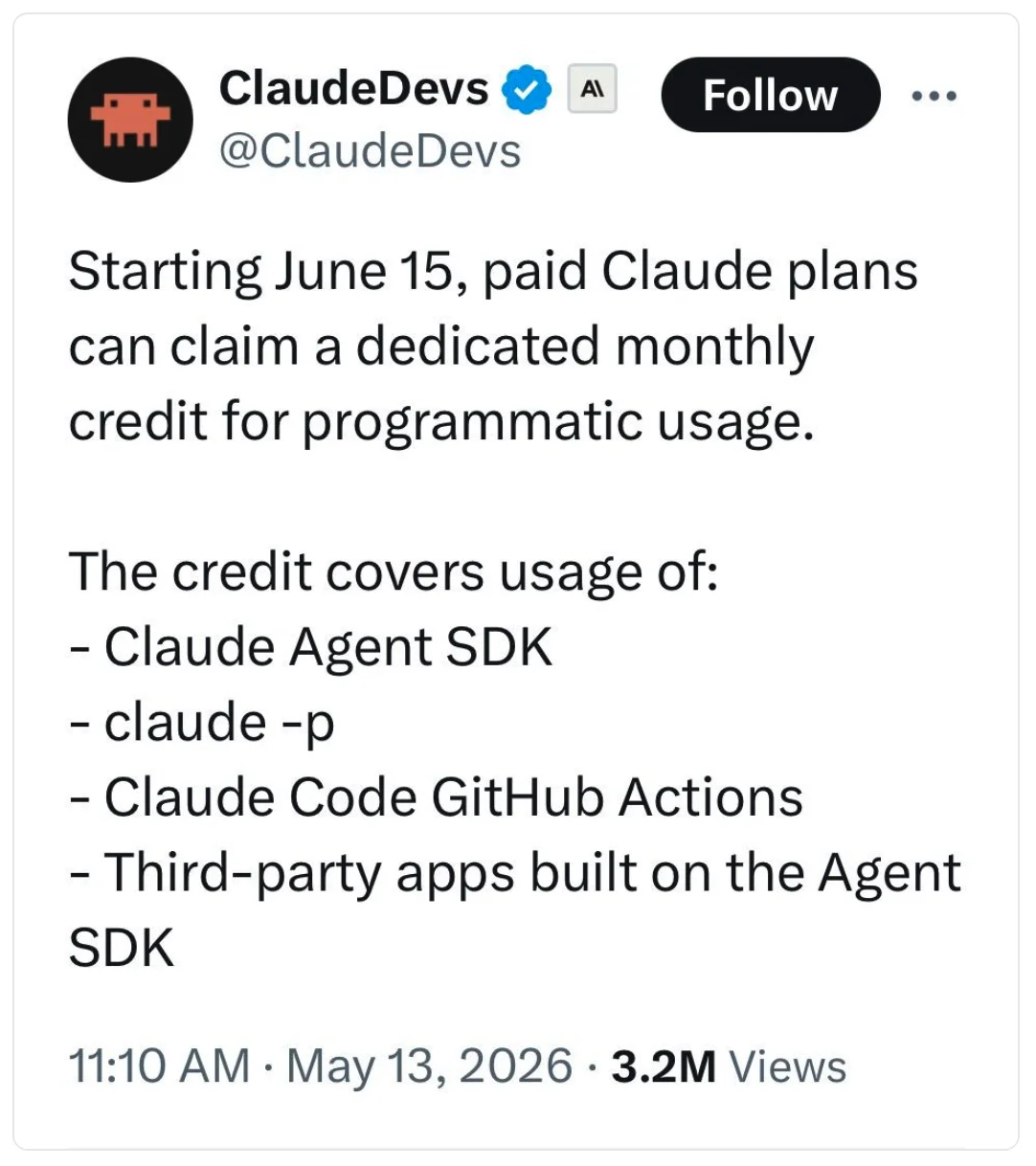
Starting June 15, 2026, paid Claude subscriptions split into two pools. There's also a third path that the announcement doesn't restructure at all, worth naming so you can place yourself in the picture.
Interactive usage (you in the browser chatting with Claude, or you in the terminal using Claude Code to write code) stays exactly where it is. Same plan, same limits, same price.
Programmatic usage (Claude Agent SDK, claude -p, Claude Code GitHub Actions, third-party apps built on the Agent SDK) moves to a separate monthly credit pool, billed at full API rates when authenticated through a Claude subscription. (Important nuance: if you were already using the Agent SDK with a direct Anthropic API key rather than your subscription credentials, nothing changes for you. You were already paying API rates by the token. The new credit pool only affects users who were authenticating programmatic usage through their subscription.) The credit allotments:
- Pro: $20/month
- Max 5x: $100/month
- Max 20x: $200/month
- Team Standard: $20/seat
- Team Premium: $100/seat
Credits don't roll over. After the credit is used, optional "Usage Credits" continue at API rates. Anthropic's own support article is the cleanest source; InfoWorld and The Decoder have good writeups. Anthropic's stated reason: third-party agent tools were driving programmatic burn that "throw off our flat-rate pricing model."
Direct API usage (products and workflows that hit the Anthropic API with an API key, no Claude subscription involved) is entirely unchanged. API token rates have not moved (and have been moving down separately, per the prior post). The June 15 split restructures subscription plans only. If your AI strategy was built on direct API access from the start, the announcement doesn't apply to your bill. The usage-drift dynamic we wrote about still does.
This is not a generic price hike. It's a surgical re-pricing of one specific kind of usage. The other two kinds (a person typing into Claude Code, or a product talking to the API directly) are untouched.
If you want to find yourself in the matrix quickly:
| I am using… | I am paying by… | Affected? |
|---|---|---|
| Claude.ai chat | Subscription | No |
| Claude Code (interactive terminal) | Subscription | No |
| Claude Code (interactive terminal) | API key | No |
| Direct API in my own code (no SDK) | API key | No |
| Claude Agent SDK | API key | No |
| Claude Agent SDK | Subscription | Yes |
claude -p (headless mode) | API key | No |
claude -p (headless mode) | Subscription | Yes |
| Claude Code GitHub Actions | API key | No |
| Claude Code GitHub Actions | Subscription | Yes |
| Third-party tool built on Agent SDK | API key | No |
| Third-party tool built on Agent SDK | Subscription | Yes |
The pattern: subscription auth + programmatic usage equals affected. Any other combination, the announcement doesn't reach you.
Where the "10x" claim is true and where it isn't
For most subscribers, the July bill looks like the May bill.
For a specific population (developers running unattended agentic workflows, CI pipelines, scheduled bots, third-party agent tools like OpenClaw or Conductor off a Pro or Max plan), the bill can rise substantially. That's where the 10x figure comes from. If your "subscription" usage was actually agentic-loop usage by another name, that part of your usage just got moved to API rates after a small free allowance.
The honest read: a small but vocal slice of users is facing a real repricing event. Most people are not. The panic is loud because the people most affected are also the people most active in dev communities. That's a selection bias, and it shapes what the discourse looks like more than what's actually happening.
Why this confirms the framework, not breaks it
Two days ago we published Subscription Shock vs. Usage Drift. The argument was simple:
- Consumer and SMB flat-rate AI subscriptions are subsidized. The gap will close.
- API token pricing is moving the opposite direction (down, with caching and batching).
- The real risk for API-based products isn't subscription shock. It's usage drift: tokens-per-action climbing as products get more agentic.
We cited GitHub Copilot's June 1, 2026 move to usage-based billing as evidence the subscription-side gap was closing. Anthropic just made the same move. Two of the major coding-AI vendors restructured flat-rate pricing within two weeks of each other.
That's not a coincidence. Both hit the same wall: flat-rate works for predictable human-driven usage and breaks under unpredictable agentic usage. Both responded by metering the agentic side and leaving the human side alone.
Anthropic's framing in their own announcement is almost a clean restatement of the dynamic the post describes. Third-party agent tools "throw off our flat-rate pricing model" is another way of saying "agentic usage exhibits drift that subscription pricing can't absorb."
The structurally interesting move: split bundling
What's novel about Anthropic's answer is the shape, not the prices.
They didn't kill flat-rate. They didn't just raise prices on everyone. They split one bundle into two. The principle is that some kinds of usage have a natural ceiling and some don't; flat-rate works for the first kind and breaks for the second; carve the second kind out and meter it separately.
That principle is correct. Usage drift (the dynamic we named in the prior post) only bites the unbounded side. If your usage stays bounded by a human's attention, your tokens-per-action has a natural cap. If your usage migrates into autonomous loops, your tokens-per-action has no cap. A vendor splitting along that line is doing real economics.
The original post argued there were two pricing models moving in opposite directions. The honest update is that there are now three things to track:
- Consumer/SMB flat-rate subscriptions: being reformed
- API token pricing: still moving down
- Split bundles: the operational answer that lets flat-rate survive for predictable usage by carving out unpredictable usage to be metered
The third is the new structure. Expect to see it from other vendors over the next 12 months.
Where the seam runs, and where it should
The principle is sound. The specific seam Anthropic drew is more contestable than the announcement made it look, and the critique deserves engagement.
Theo Browne, who builds T3 Code (an open-source coding wrapper that uses the Claude Agent SDK), walked through the issue in detail:
His core point is structural, not emotional. Anthropic framed the split as interactive vs. programmatic. In practice, it functions as Anthropic's UI vs. any other UI. Tools like T3 Code, Zed's Claude integration, and Gene are interactive (a human is sitting at the keyboard, driving, with all the natural rate-limiting that implies), but because the UI isn't Anthropic's, they're now classified as programmatic and metered against the same $20/$100/$200 credit pool that applies to fully unattended CI jobs and third-party agent farms.
That conflation matters. Conductor and OpenClaw running as automated cron jobs really are a different load profile from an OSS wrapper a human is using to write code. Treating them as the same category does work the principle doesn't require. It also lands hard on developers who built carefully on the Agent SDK based on Anthropic's earlier guidance. Multiple Anthropic employees explicitly told developers through early 2026 that personal and OSS tools wrapping the harness were fine. The change reverses that without acknowledging the reversal.
A cleaner seam (the one we'd argue for if we were designing this) splits on who's driving, not whose UI is on the screen:
- Flat-rate side: Any human-in-the-loop usage. Direct Claude Code use, Claude.ai chat, and OSS or third-party UIs that a human is actively driving. The user's attention provides the natural rate-limiting.
- Metered side: Any agentic-autonomous usage. CI pipelines, scheduled jobs, third-party agent loops, anything that calls the model in an unattended loop without a human per call.
That seam matches the load profile that's actually breaking flat-rate. The seam Anthropic chose is a proxy for that load profile. A noisy one, because it bundles low-burn interactive OSS tools with high-burn agent farms into the same category.
This is worth saying directly: when bundles split, the placement of the seam matters more than the existence of the split. A vendor splitting along a sharp load-profile line is doing good economics. A vendor splitting along a "is the UI ours" line is doing something closer to platform lock-in. Anthropic's announcement reads as the first; the implementation drifts toward the second.
We expect to see more vendors split bundles over the next 12 months as agentic usage normalizes across products. The seams they choose will say more about their long-run posture toward third-party builders than the split itself does. Watch where they put the line.
Who should be paying attention vs. who's mostly fine
Mostly fine:
- Developers who use Claude.ai or Claude Code interactively to write code. Same plan, same limits, same bill.
- Companies building AI products on the Anthropic API rather than on subscription seats. API rates haven't changed.
- Pro and Max users whose programmatic usage fits inside their new credit ($20, $100, or $200 of API-rate budget per month).
Should be paying attention this week:
- Anyone running unattended agentic workflows off a consumer subscription plan. Map your current Claude Code SDK / Agent SDK / GitHub Actions usage against the credit you'll have on your tier, and decide what happens after the credit runs out.
- Companies that handed out hundreds of Pro or Max seats and let teams use them for production-adjacent agentic tooling. This is the seat-as-enterprise-infrastructure pattern we flagged in the prior post as most exposed to repricing. Anthropic just shipped the repricing.
- Developers using OSS Claude wrappers (T3 Code, Zed's Claude integration, Gene, similar). You're interactive in everything but classification. Until or unless the seam is redrawn, your usage now draws from the credit pool.
The 10x figure is shorthand for the cost increase in these groups. It is real for them. It is not a 10x increase across the board, and reading it that way leads to the wrong response (panic, churn-talk) instead of the right one (re-architect your seat strategy and, if you're an OSS wrapper user, watch whether Anthropic refines the seam under pressure).
What this means for product owners, practically
Likely answer: not much. Your product shouldn't be running on consumer subscriptions in the first place. Production AI products are built on the API, where pricing is unchanged.
The exception worth checking this week:
- Dev, test, and pilot environments. If anyone on your team is using a personal Pro or Max subscription to power agentic tooling that touches your roadmap, that line item is what just got repriced.
- Cost visibility per feature and per customer. Instrument it before the next vendor change forces the question.
- Vendor seam philosophy. Where the next vendor draws this same line tells you how much vendor risk lives in your product.
The teams handling this calmly already had cost visibility before they needed it. The teams scrambling treated AI cost as a vendor's problem.
What this means for builders, practically
The design implications haven't changed from the prior post. If you're building AI products, the work is still:
- Treat prompt caching as architecture, not optimization.
- Route to the cheapest model that can handle the task. Haiku for classification, Sonnet for most work, Opus where it earns its keep.
- Put hard iteration caps on agents.
- Instrument cost per customer and per feature from day one.
- Model unit economics at 2x, 5x, and 10x usage growth, not at today's usage.
What changed: if your product runs on subscription seats rather than direct API access, the urgency on this list just went up. Anyone whose AI strategy was "buy seats, point agents at them, hope for the best" needs a different strategy. The good news is that the same disciplines that make API-based products durable under usage drift also make subscription-based products durable under split bundling. The work is the work.
The bigger lesson
The community framing right now is "they raised the prices." A more accurate framing is "they split a bundle that was never going to hold together, and the seam they chose has consequences."
The split itself is good economics. The seam is where the politics live. A vendor who splits along load profile is responding to the same dynamic every other vendor is going to have to respond to. A vendor whose seam also happens to disadvantage open-source alternative UIs to their own closed-source one is doing two things at once and only naming the first.
The AI economy is sorting out which kinds of consumption belong in which kinds of contracts. Anthropic's split is one cut at the question. GitHub's full move to usage-based is another. We'll see more answers from more vendors over the next year, and the ones that hold up will be the ones that match price structure to load profile honestly rather than using load-profile language to do platform-control work.
Two days ago we said the gap would close. It's closing. The shape is more interesting than the original framing suggested, and the placement of the seam is more interesting than the existence of the split. Both are worth tracking for anyone whose product touches an LLM bill.
If you've read the original post, you already have the framework. Anthropic gave the cleanest worked example of the dynamic playing out in real time. And a worked example of how the implementation of the right principle can land in a less-than-right place.
Frequently asked
What did Anthropic actually announce on May 13, 2026?›Starting June 15, 2026, paid Claude subscriptions split into two pools.
Is Claude really getting 10x more expensive?›For most subscribers, no. ai and Claude Code is unchanged.
Why did Anthropic do this?›Anthropic's own rationale is that third-party agentic tools like Conductor and OpenClaw drove heavy programmatic burn that broke their flat-rate model.
Does this affect companies building products on the Anthropic API?›Not directly. API token pricing has not changed.
Who's most exposed to this change?›Companies that treated consumer subscriptions as enterprise infrastructure, issuing hundreds of Pro or Max seats and pointing programmatic tooling at them.
Did Anthropic draw the seam in the right place?›The principle of split-bundling is sound. The specific seam Anthropic drew is more contestable.
Let’s build it together.
We turn clever prototypes into production systems people can rely on. If you’re building with agents and want a hand making it real, leave your email and we’ll be in touch.