Code Was Never the Job. Now Your Ideas Are the Bottleneck.
Here is a fact that should be strange and isn't: the highest-level engineers at most companies write the least code. A staff engineer can go a week barely touching a keyboard and still out-earn the people shipping hundreds of lines a day. If pay tracked code volume, that would be backwards. It isn't backwards. It's the tell.
So what were they actually being paid for?
What were software engineers actually paid for?
They were paid for systems thinking, not for typing. How to organize a system so it scales. How to sequence the work around the real bottlenecks. How to prepare for the next release. How to ship reliably without shaking the confidence of the people who depend on it. That is the job. Code was just the slowest part of doing it.
A senior engineer's reel that's been making the rounds put it more bluntly than I would have dared: engineers were never paid because they wrote code, it's one of the great lies of the industry. The reason they wrote code is that it was the slow part, and you needed people with scarce syntax skill just to get through it.
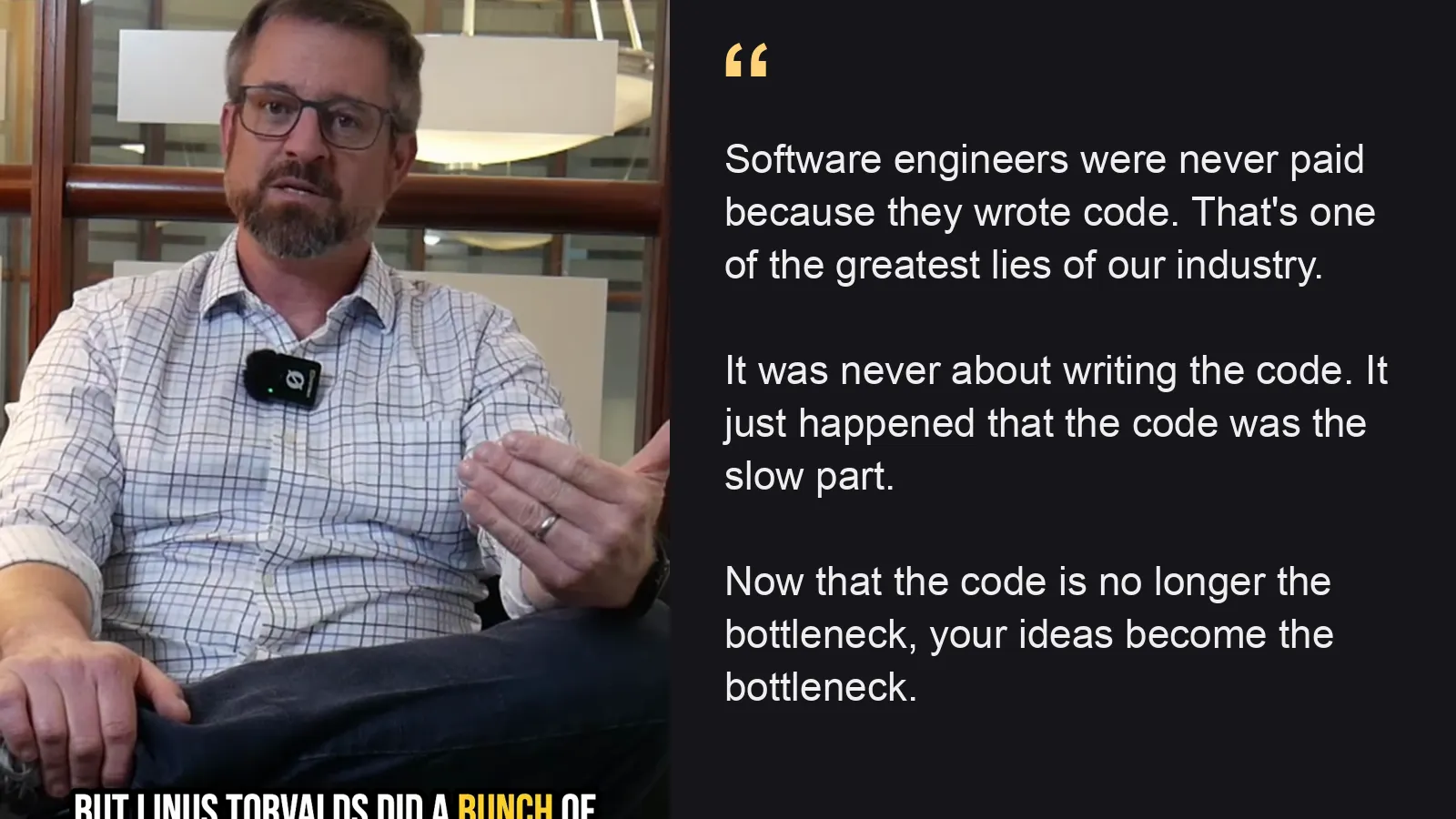
It was never about writing the code. It just happened that the code was the slow part.
That line reframes the whole anxiety of this moment. For decades, the syntax was the wall. Clearing it took years of practice, so the people who could clear it fast looked like the value. They weren't the value. They were the toll booth on the road to the value.
If AI writes the code, what is the new bottleneck?
When code stops being the slow, expensive step, the constraint does not vanish. It moves up the stack to ideas and judgment. The question changes from "can we build this" to "do we actually know what's worth building, and how to shape the system around it."
This is the part the "AI replaces engineers" panic gets exactly backwards. AI is dissolving the code bottleneck, the same way compilers dissolved the assembly bottleneck and high-level languages dissolved the compiler bottleneck. Each time the slow part got automated, the work didn't disappear. It moved to whatever became the new slow part. This time the new slow part is the thinking: the spec, the architecture, the call about what to build and what to leave out.
That is the whole hero image above. The pinch in the channel doesn't go away when you clear it. It travels up to the next narrow point. Right now it's traveling from code to ideas.
The reframe matters because the public conversation is stuck in a binary. One side says AI replaces developers. The other says it's just fancy autocomplete. Both are arguing about the code. Neither notices that the code was never where the value lived, so automating it doesn't settle the question, it relocates it.
Why does this expand who can build instead of replacing developers?
Because the barrier that's falling is the syntax wall, and that wall is what kept domain experts out. When code was the bottleneck, the only people who could build were the people who'd spent years learning to clear it. Remove it, and the person closest to the problem can move into the build directly.
We've written before that AI isn't replacing developers, it's expanding who builds, and that who creates software is changing. This is the sharper version of that argument. The product manager who knows the customer cold, the operator who has run the workflow a thousand times, the domain expert who understands the regulation better than any engineer ever will: each of them was previously blocked at the syntax wall. Now they can sit much closer to the actual building. That's expansion. It's more builders, not fewer.
It also fits the oldest thing we believe: the person closest to the problem should be closest to the build. For years that was aspirational, because closeness to the problem and ability to clear the syntax wall were two different skills that rarely lived in the same person. AI is collapsing that gap.
Does this mean engineering skill stops mattering?
The opposite. Systems thinking, taste, and the discipline to ship reliably matter more now, not less, because the thing that's suddenly abundant is code and the thing that's still scarce is the judgment to direct it.
When everyone can generate a working prototype in an afternoon, the differentiator is no longer who can produce output. It's who can tell good output from output that merely looks done. That judgment is exactly the engineering fundamentals that don't go away in the AI era: knowing what will break under load, what will rot into unmaintainable debt, what the system needs to do that nobody asked for yet. Generating code got cheap. Knowing whether the code is right did not.
So this is not a story about skill becoming obsolete. It's a story about which skill the market pays for becoming visible. The engineer who masters the new tools and brings systems judgment to them becomes more valuable. The one standing on the lawn insisting that real engineers write every line by hand is optimizing for the toll booth right as the toll gets abolished.
What should builders optimize for now?
Optimize for clarity of intent, not volume of output. The spec, the architecture, the sequence of what to build first, the judgment about what's worth building at all. That is where leverage now lives, and it's the muscle worth training.
Concretely, stop measuring yourself in lines written or typing speed, and start measuring whether you can state the right thing to build clearly enough that a capable agent could execute it. That clarity is the new scarce skill. It's the same reason product thinking matters more when everyone can build: when execution is cheap, the quality of the direction is the entire game. AI amplifies whatever intent you give it, so a vague intent gets amplified into expensive noise and a sharp one gets amplified into a real product.
Vibe coding, the loose prompt-and-see-what-happens style that gets dismissed as a toy, is worth a fair word here. It isn't the finished discipline. It's the on-ramp. It's what it looks like when someone who couldn't previously build starts building, before they've layered systems judgment on top. The mistake is treating it as the destination instead of the first step up a stack that now goes much higher.
Code was never the moat. Ideas were. We just couldn't see it clearly while the code took so long to write that it filled the whole frame. Now the slow part is fast, the frame is clear, and the bill comes due on whoever has the sharpest thinking. The advantage goes to the people who build as if that were always true. Because it always was.
Frequently asked
What were software engineers actually paid for?›For systems thinking, not for typing. How to structure a system so it scales, how to sequence work around bottlenecks, how to ship reliably without breaking user trust.
If AI writes the code, what is the new bottleneck?›Ideas and judgment. Once generating code stops being the slow, expensive step, the constraint moves up the stack to knowing what to build and how to shape the system around it.
Does AI replace developers?›No. It removes the syntax barrier that made code the bottleneck, which expands who can build rather than shrinking the field.
What should builders optimize for now?›Clarity of intent over output volume. The spec, the architecture, the sequence, and the judgment about what's worth building.
Let’s build it together.
We turn clever prototypes into production systems people can rely on. If you’re building with agents and want a hand making it real, leave your email and we’ll be in touch.