Your Expertise Stopped Being a Moat. Firsthand Proof Is What's Left.
Pick any "six-figure blogger" from a 2022 success roundup and look them up today. The most likely thing you will find is a site running on about one-seventh of its old traffic.
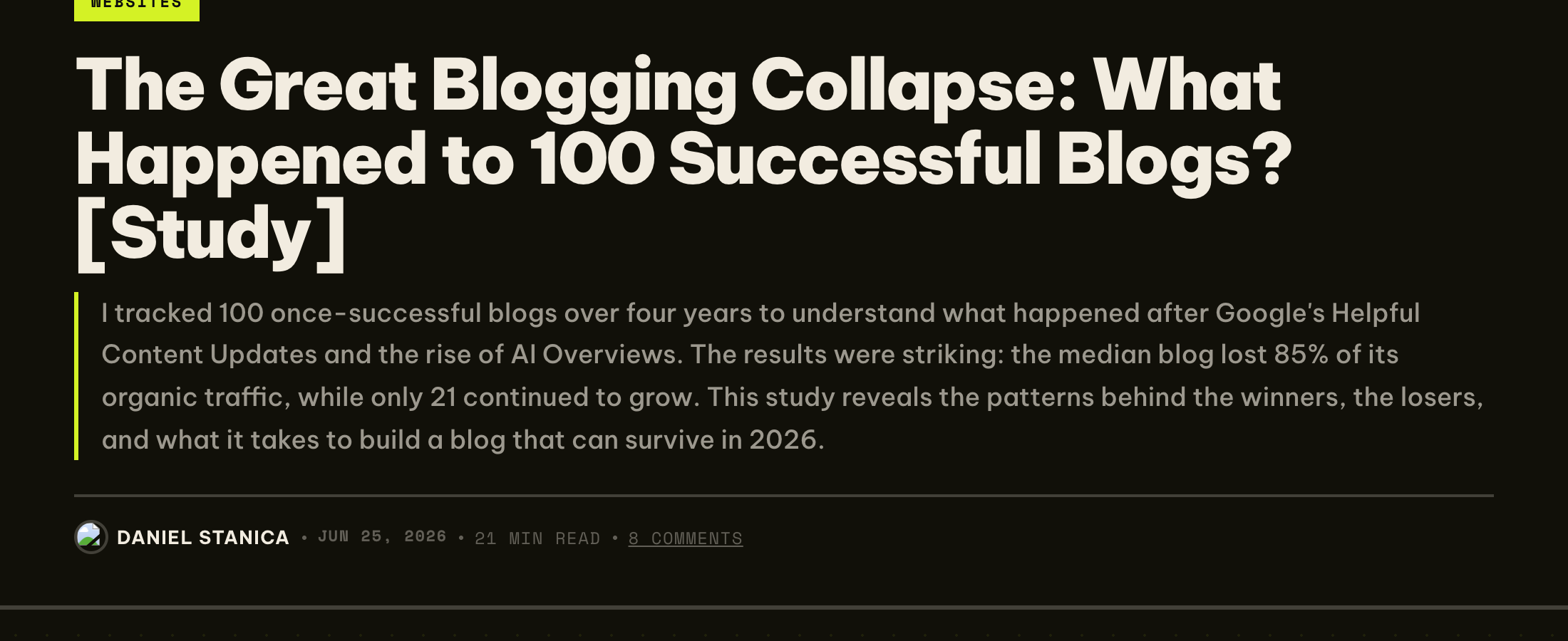
That is not a guess. Daniel Stanica tracked 100 blogs that were each earning six figures in 2022 and followed them through 2026. The median lost 85% of its organic search traffic. Only 21 out of 100 still grew.[1]
The instinct is to blame Google updates, or to assume the losers got lazy. Both miss what actually happened. The line between collapse and growth was not quality.
It was summarizability.
Why did so many blogs lose traffic to AI Overviews?
Because most of them described things that were already consensus, and description is exactly what an answer engine reproduces for free. In Stanica's cohort, the niches that collapsed were the ones restating settled knowledge; the ones that held or grew documented firsthand experience a summary cannot replace.
Look at the divide by niche. Finance blogs lost a median 99% of their traffic. Fashion lost 95%. Health lost 93%, and make-money-blogging advice lost 93%. Meanwhile parenting blogs grew 108%, and DIY held at +2%.[1]
Stanica's own diagnosis of the health niche is the whole story in one sentence: "There is no firsthand moat in summarizing what's already a medical consensus, and the answer engine took it wholesale."[1]
He is careful to call this what it is: a tracked cohort, not a controlled experiment. So put the controlled evidence under it.
Pew Research followed 900 US adults through 68,879 real Google searches in March 2025. When an AI Overview (the AI-written answer Google now places above the results) appeared, people clicked a traditional result on just 8% of visits, versus 15% without one. They clicked a link inside the AI answer only 1% of the time.[2]
On 26% of those pages, the search simply ended there. No click at all.
And the AI answer is spreading. Pew measured it on 18% of searches in early 2025; BrightEdge's tracker put it near 48% by early 2026 (trackers differ on method, all show the same climb). Seer Interactive, watching 2.4 billion impressions, measured organic click-through on AI-answer queries falling from 1.76% to 0.61%.[3]
The visit stopped being necessary because the answer arrives before it. Multiple forces hit these sites at once (Google's core updates did real damage too), but one thread runs through every casualty: summarizable value stopped requiring a click.
What is a content moat in the age of AI answer engines?
A content moat is the reason a reader needs you specifically, rather than a summary of you. Keywords, comprehensiveness, and consensus authority no longer qualify, because an answer engine restates all three instantly. What qualifies now is anything a summary cannot deliver without sending the reader to you.
Here is the uncomfortable reframe for every subject-matter expert: your expertise is not the moat you think it is. If what you publish is consensus knowledge stated well, the model knows it too, and it will hand your value to the reader without the reader ever meeting you.
Knowing is now a commodity input. Doing is not.
Build only where value can't be delivered to a reader via an AI summary without them needing you.
That sentence is the whole strategy, so make it operational. Call it the AI Summary Test, and run it on every page you publish: can an answer engine give the reader this value without them needing me? If yes, that content is annihilation-bound, however well written. If no, it is a moat. Build where the answer is no.
How do subject-matter experts build a moat AI can't copy?
Stop publishing what you know and start publishing what you have done. Four kinds of content pass the AI Summary Test, and all four are things you have done or built rather than things you know.
- Firsthand results. The project you actually ran, with the real numbers and the parts that went wrong. A summary can restate your conclusion; it cannot have run your project.
- Proprietary data. Something only you measured. A model cannot synthesize a dataset that exists nowhere else.
- Judgment. The specific call you would make on the reader's specific situation. A consensus average cannot render a verdict; that is why the person closest to the problem keeps winning.
- Owned relationship. An audience that comes to you by name, so the answer engine is not even in the path.
Notice what this rhymes with. When generation became free, producing the words stopped being the bottleneck, and value moved to what cannot be generated. The blogging collapse is that same shift, measured at the content layer.
Differentiation when everyone can build was never going to come from output volume. Your expertise still matters, but as the foundation you build proof on, not the moat by itself.
Does ranking number one on Google still matter?
Less than it used to, and not in the way you think. Even the top result loses roughly half its clicks when an AI answer sits above it, and ranking well no longer guarantees the answer engine quotes you. Rankings became a customer-acquisition channel, not the business itself.
The distribution twist surprises even good operators: being right is no longer enough to be seen. One analysis Stanica cites found only about 38% of AI citations now come from top-10 organic results, down from 76% in mid-2025.[1] You can be the source and still not be the one quoted.
Which means the durable asset is an audience you own, not a position you rent from an algorithm. The survivors in the cohort converted melting search traffic into email lists, communities, and names people search for directly, before the melt finished. The ones who treated search as the business went to zero with it.
For anyone holding a declining property, the triage runs in order:
- Consolidate. Cut the summarizable pages and concentrate on the firsthand ones. Thirty pages of genuine experience beat five hundred pages of restatement.
- Convert. Turn the search traffic you still have into an owned audience now, while it exists.
- Productize. Turn that trust into things a summary structurally cannot be: tools, services, cohorts, judgment applied to their specific problem.
The strategic shift underneath all three: treat your firsthand experience as the product, and search as one channel to it. Not the other way around.
The answer engine is not your competitor for knowing. It has already won that game, and it was never the game worth playing. It cannot run your project, measure your data, make your call, or be the person your audience trusts. Build there, where the summary needs you and cannot replace you.
That was the only moat that ever held. Most people just never needed to find out until now.
References
- ^1.Daniel Stanica, “The Great Blogging Collapse: What Happened to 100 Successful Blogs? [Study]” (June 2026)
- ^2.Pew Research Center, “Google users are less likely to click on links when an AI summary appears in the results” (July 2025)
- ^
Frequently asked
What is a content moat in the age of AI answer engines?›A content moat is the reason a reader needs you specifically rather than a summary of you.
Why did so many blogs lose traffic to AI Overviews?›Because most of them described things that were already consensus, and description is exactly what an answer engine reproduces for free.
How do subject-matter experts build a moat AI can't copy?›Stop publishing what you know and start publishing what you have done.
Does ranking number one on Google still matter?›Less than it used to, and not the way you think. Ranking high no longer guarantees the answer engine quotes you: one analysis found only about 38% of AI citations now come from top-10 organic results, down from 76% in mid-2025.
What should an expert or business do about declining search traffic?›Triage in order. Consolidate: cut the summarizable pages that no longer earn a click and concentrate on the firsthand content only you can produce.
Let’s build it together.
We turn clever prototypes into production systems people can rely on. If you’re building with agents and want a hand making it real, leave your email and we’ll be in touch.