The Best Sales Books for Founders, Ordered by When You Need Them
More founders than ever are hitting the same wall at the same moment: the product exists, the customers don't. Two years ago the product was the hard part. Now a domain expert can ship something real in weeks, which means the scarce skill has moved from writing code to collecting customer evidence. The bookshelf hasn't caught up.
Why do most sales books fail founders?
Because they're written for professional reps inside working sales machines: a team, a pipeline, a quota, someone else booking the meetings. A pre-revenue founder has none of that. Advice built on enterprise scaffolding doesn't just underperform at customer zero, it points you at the wrong work entirely.
And for roughly the first twenty customers, the work can't be delegated. Early sales isn't a professional sales motion; it's learning, and the learning has to land in your head, because it feeds every product and positioning decision you'll make. Paul Graham put the uncomfortable part plainly[1]:
You can't wait for users to come to you. You have to go out and get them.
Every list of the best sales books for entrepreneurs ranks by fame and implies you should read them all. This one is ordered by bottleneck: eight books that work when it's just you, each placed at the customer count where it becomes useful, each with an honest line about who should skip it.
What order should you read them in?
Locate yourself by customers closed, not chapters read. The sequence runs from The Mom Test at customer zero to Predictable Revenue, deliberately parked at customer twenty. Start wherever you're stuck right now; a book read ahead of its bottleneck is a book you'll have to read twice.
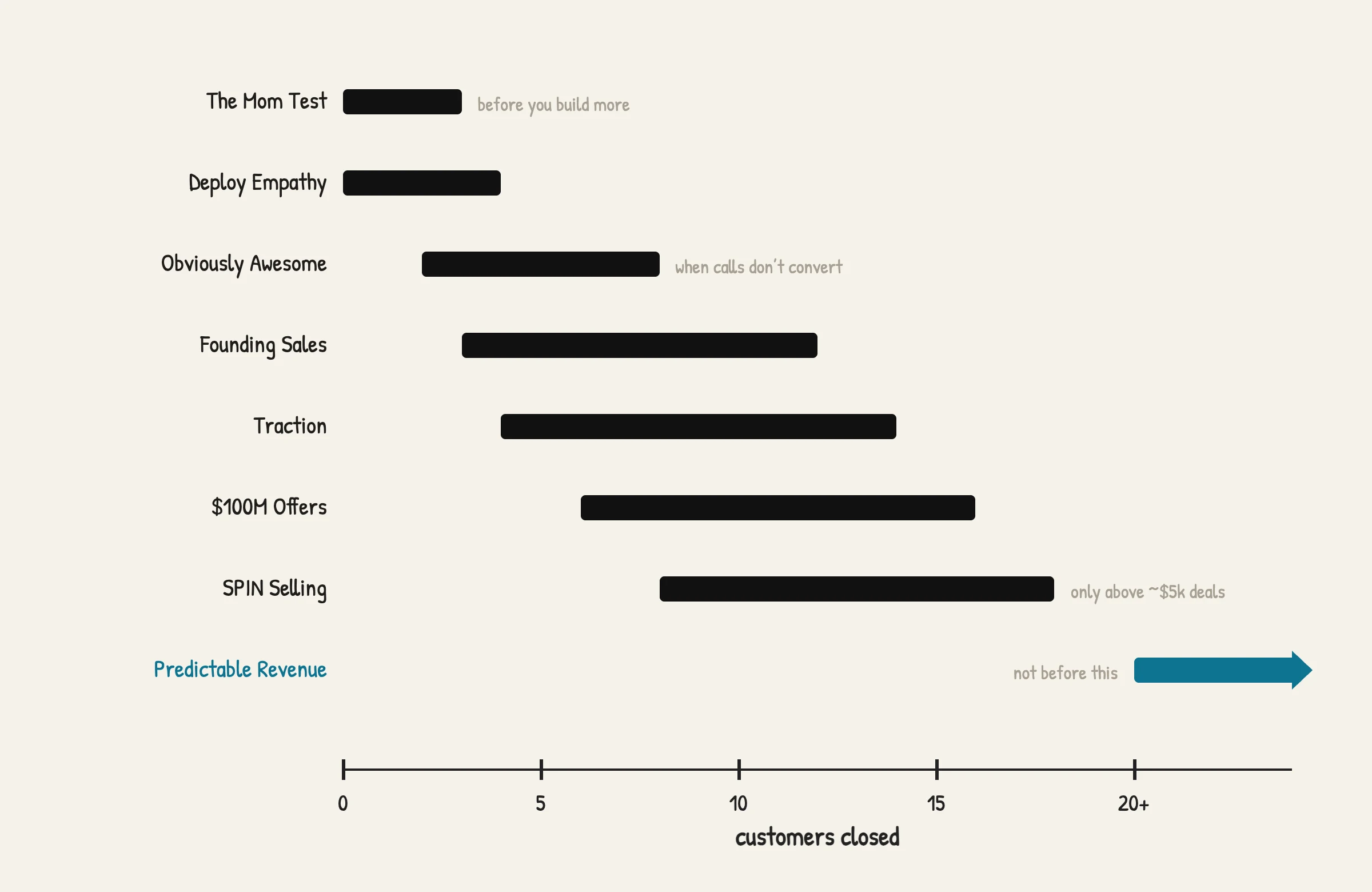
The cover images link to Amazon. As an Amazon Associate, Generative Labs earns from qualifying purchases.
The Mom Test (Rob Fitzpatrick, 2013)
Read this if: you haven't talked to ten real prospects yet, or you have and every conversation felt encouraging but went nowhere.
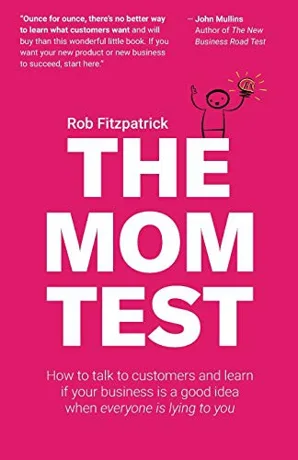
Fitzpatrick's core rule: questions about the future produce false positives. "Would you buy this?" invites a polite lie; "what did you do the last time this came up?" produces evidence. This is customer discovery stripped to its usable core, and it's how the person closest to the problem converts proximity into proof.
Today's move: rewrite your next customer call to contain zero questions about your idea.
Skip if: you already run disciplined discovery interviews.
Deploy Empathy (Michele Hansen, 2021)
Read this if: The Mom Test convinced you, but you don't know how to run the actual call.
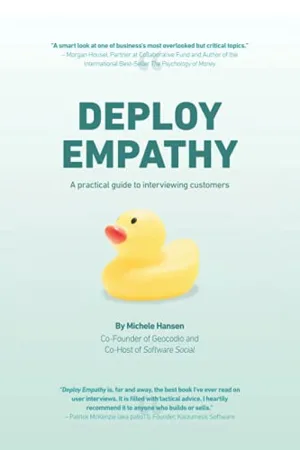
Hansen wrote the practical companion: recruiting interviewees, scripts by situation, how to listen without leading, and how to turn what you hear into decisions.
Today's move: take her recruiting-email script and send five interview invitations before the end of the day.
Skip if: interviewing already feels natural and your notes already change what you build.
Obviously Awesome (April Dunford, 2019)
Read this if: prospects say "interesting" and then ghost you. That's a positioning failure, not a product failure.
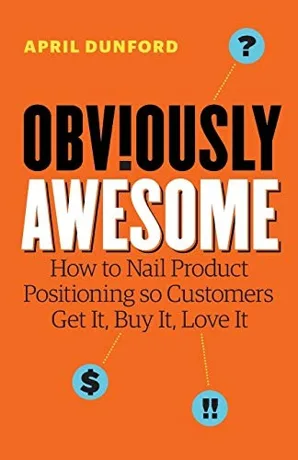
Dunford's five-component positioning exercise (competitive alternatives, unique attributes, value, target segment, market category) is the most useful hour a confusing pitch can buy.
Today's move: list what your customer would actually use if you didn't exist. Spreadsheets and interns count. That list, not your rival startups, is your real competition.
Skip if: prospects consistently get what you are within one sentence.
Founding Sales (Pete Kazanjy, 2020)
Read this if: you've accepted that sales is your job for the next twenty customers and you want the full manual.
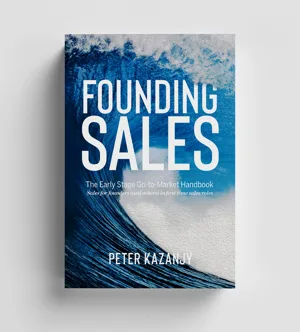
Kazanjy covers prospecting, demos, objection handling, pricing, and closing, all written for founders doing B2B founder-led sales for the first time, not for professional reps. Notice the confidence move, too: the entire book is free to read online at foundingsales.com[2], which is exactly the posture of someone whose material works.
Today's move: put a recurring two-hour prospecting block on your calendar before you feel ready. You will never feel ready.
Skip if: you've carried a B2B bag before.
Traction (Gabriel Weinberg and Justin Mares, 2015)
Read this if: you don't know where your customers hang out.
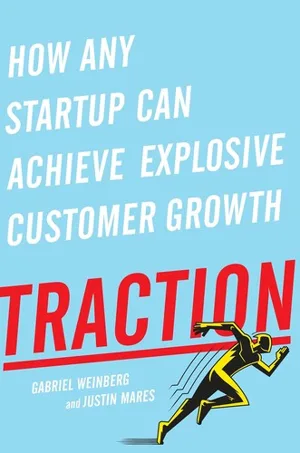
Weinberg and Mares catalog nineteen acquisition channels and the Bullseye framework for choosing among them: brainstorm all nineteen, cheaply test the three most promising, then concentrate on the one that shows signal. The alternative is defaulting to whichever channel you happen to enjoy.
Today's move: run Bullseye on paper this afternoon. It takes an hour and usually kills at least one comfortable assumption.
Skip if: one channel is already visibly working and your problem is doubling down, not searching.
$100M Offers (Alex Hormozi, 2021)
Read this if: your offer gets slow maybes instead of fast yeses.

The title, the cover, and the personal-brand machine around this book read as exactly the genre I usually avoid, and skipping it for those reasons would cost you the best practical material on offer construction in print. The substance: the value equation, risk reversal, and guarantees; how to assemble an offer concrete enough that saying no feels like losing something.
Today's move: add one risk-reversal element to your current offer this week (a pilot period, a results guarantee, an easy exit) and watch what it does to the conversation.
Skip if: your offer already converts and your bottleneck is volume.
SPIN Selling (Neil Rackham, 1988)
Read this if: you sell a large, considered purchase where the discovery conversation is the sale.
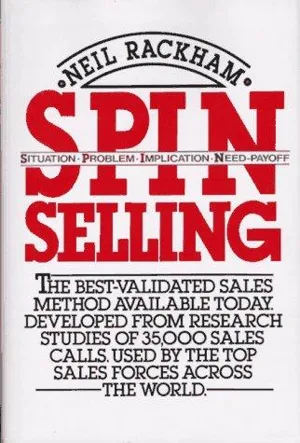
The oldest book here, and the only one built on large-scale field research into what top performers actually do differently on major sales: they ask Situation, Problem, Implication, and Need-payoff questions instead of pitching.
Today's move: in your next serious deal conversation, replace the pitch with implication questions ("what does this problem cost you when it hits at quarter-end?") and let the prospect argue for the purchase.
Skip if: your average deal is under roughly $5k. Below that, the considered-purchase machinery is overkill.
Predictable Revenue (Aaron Ross and Marylou Tyler, 2011)
Read this if: you've personally closed about twenty customers and founder-led sales is saturating your calendar.
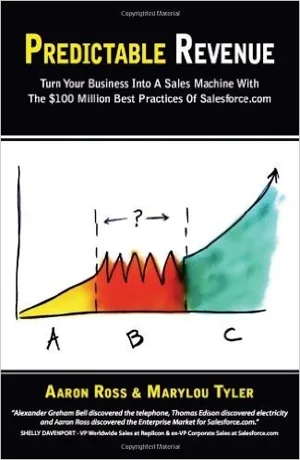
The deliberate outlier. Ross and Tyler teach outbound systems, specialized roles, and pipeline machinery: the playbook for scaling something repeatable, and a trap if nothing repeatable exists yet. Its place on this list is teaching you what not to build yet, because hiring an SDR before you've closed twenty customers yourself outsources the learning right when it matters most.
Today's move: none, and that's the point. Bookmark it.
Skip if: you're anywhere before customer twenty. That's most readers of this post, and that's fine.
If you only read one
Read The Mom Test this week, then go have ten conversations. Everything else on this list gets more useful once you have real objections, real hesitations, and real past behavior to work with.
The larger point is the one this blog keeps arriving at: building was never the moat, and in the AI era it isn't even the bottleneck. Building the right thing was always the hard part, and the founders who win from here are the ones who treat customer evidence as the scarce input. The tools collapsed the cost of shipping. Nothing collapsed the cost of knowing. Go collect it in person.
References
Frequently asked
What books should a founder read to get their first customers?›Eight books cover the whole journey from customer zero to customer twenty, in this order: The Mom Test (customer interviews that produce real evidence), Deploy Empathy (how to actually run those calls), Obviously Awesome (positioning, for when prospects say 'interesting' and ghost), Founding Sales (the full founder-led B2B sales manual, free to read online), Traction (finding your acquisition channel with the Bullseye framework), $100M Offers (constructing an offer people say yes to), SPIN Selling (structuring conversations for large considered purchases), and Predictable Revenue (outbound systems, but not until around customer twenty).
What order should you read startup sales books in?›Read by bottleneck, not by fame. Start with The Mom Test before you write another line of code or copy, because everything downstream depends on real customer evidence.
Is The Mom Test worth reading before building a product?›Yes, and it is the one to read this week if you read only one.
Do technical founders really need to learn sales?›For roughly the first twenty customers, yes, and nobody can do it for you.
Which sales books can early-stage founders skip?›Skip SPIN Selling if your average deal is under roughly $5,000: its research-backed method is built for large, considered purchases with long sales cycles.
Let’s build it together.
We turn clever prototypes into production systems people can rely on. If you’re building with agents and want a hand making it real, leave your email and we’ll be in touch.