Anthropic's Junior Hires Fell to 9% and Its Report Says Judgment Is the Bottleneck
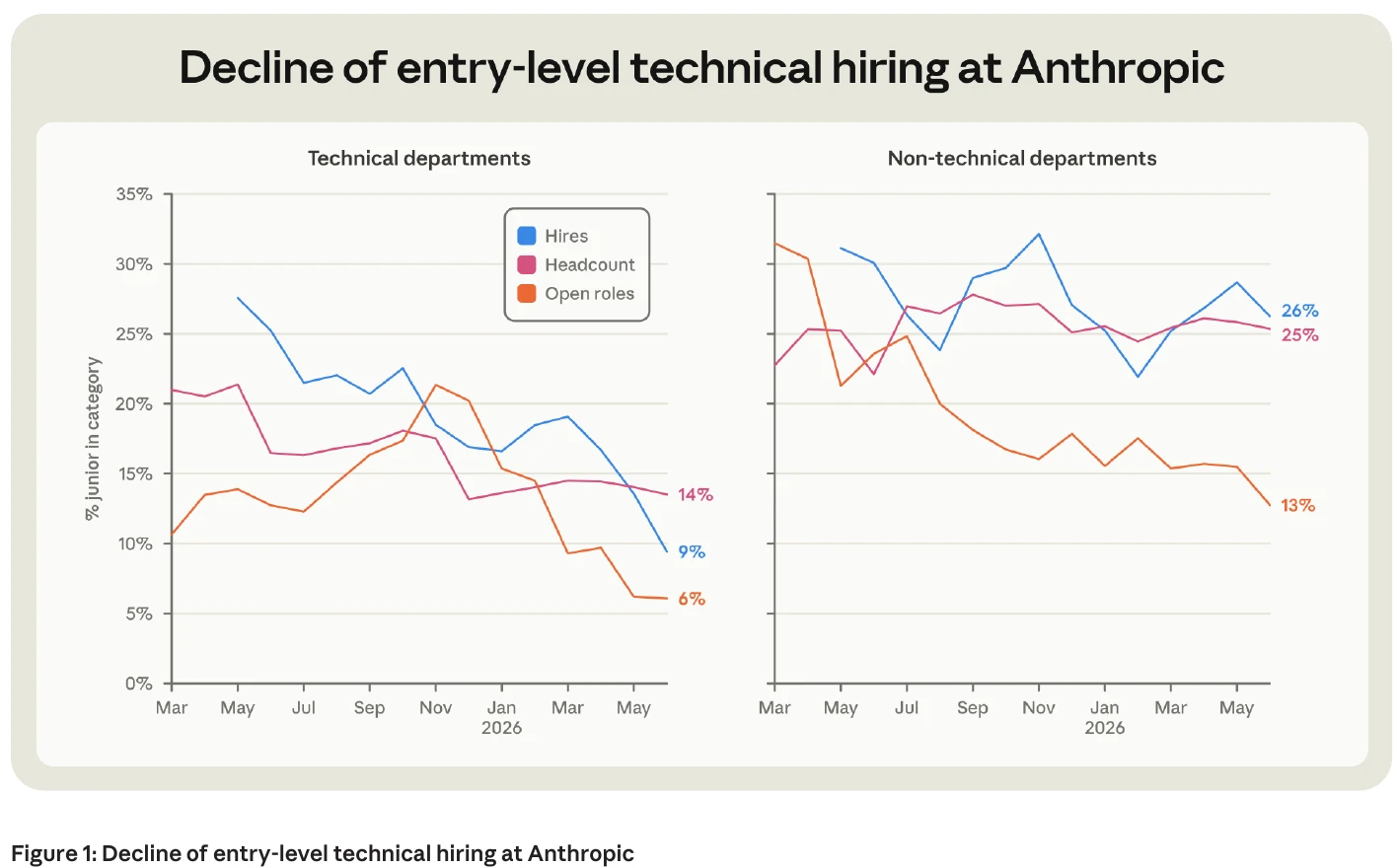
On October 16, Anthropic published a report on its own workforce. Since early 2025 the junior share of its technical hires has fallen from 27 percent to 9 percent, and the junior share of technical headcount from 21 to 14 percent. Postings for juniors "have fallen particularly sharply since December 2025."[1]
Two days later the same company committed 5 percent of its shares to a public benefit fund whose stated concerns include "instability for many workers."[2]
The measurement and the remedy, two days apart.
The coverage read the first number as the story: agents do the junior work now, so the company needs fewer juniors. The same report carries a second number that matters more to anyone running a team, and it changes what you should copy from Anthropic.
Why did Anthropic cut junior hiring?
The report says newly capable models made writing code and finding bugs offloadable, hiring managers reorganized around autonomy and judgment, and about a third of machine-learning managers and a fifth of software managers reported hiring less because of AI.[1] Every figure is a share. The company grew, and it says technical hiring kept growing in absolute terms.
Three readings went up within two days, and I am not adopting any of them.
- Agents do the junior work now. The Decoder's headline was that Anthropic "has nearly stopped hiring junior staff because AI agents now work six times as many hours."[3] That is a share claim repeated as a count.
- No juniors now, no seniors later. The first Hacker News reply, from OuterVale: "with no new juniors there will be no new seniors."[4] Right pipeline, wrong clock, and I will come back to it.
- It is advertising. In pyrale's words, there "simply is no way to separate what's reporting and what's advertising." The methods section answers that: 192 engineers who adopted coding agents against 74 who did not, 17 interviews, and the authors' own warning that "tool adoption is not random."
What does the report say the human job became?
Deciding what agent output means. By August, interactive agent hours reached six times human hours, on the company's own telemetry, and Claude sessions spend about 80 percent of their time waiting for a person. Meta-work, meaning building and monitoring agents rather than doing the task, rose from 10 to 22 percent of sessions in six months.[1]
Amid this model-driven acceleration, human attention is a constant bottleneck.
One engineer's phrase for it is that people are "bottlenecking the agents." In the April survey, 20 percent of employees described their role shifting "from actually doing work to managing Claudes," and the median employee spends 20 percent more time in meetings than a year ago, 16 percent more among technical individual contributors.[1]
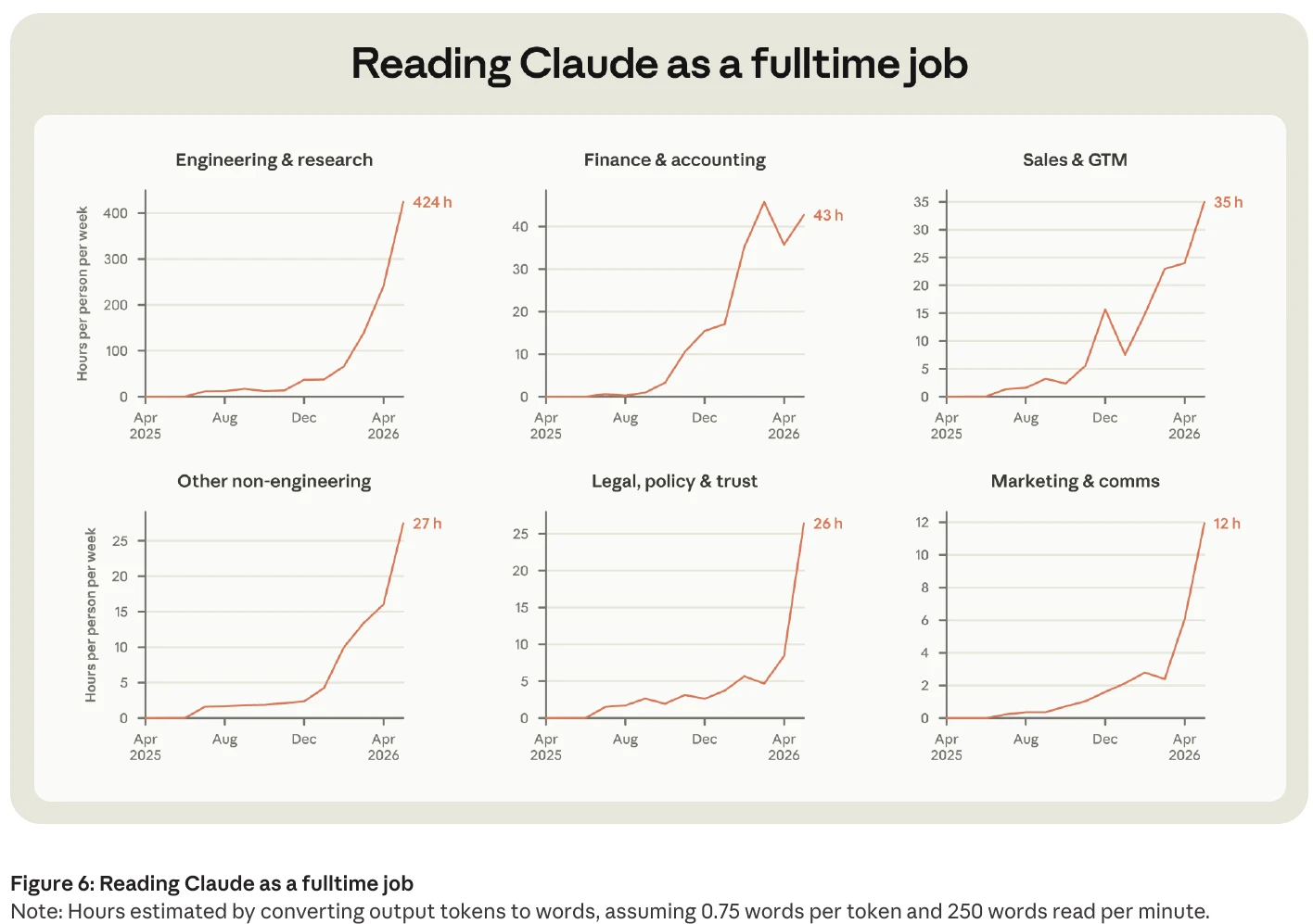
The report even priced the reading. Converting agent output to words at a normal reading speed, keeping up with Claude's interactive output in engineering and research would have taken about 424 hours per person per week by spring 2026.
Hiring moved with the work
In 2024, hiring managers mentioned a candidate's track record with AI tooling in about 5 percent of technical assessments and 7 percent of the rest; by 2026 those rates had tripled and quadrupled. Among technical interviews the biggest increase was in comments on autonomy and judgment, and domain expertise shrank as a share.[1]
We found the same shape on October 18 at PostgreSQL and inside Anthropic's own review tooling, where the review is the disposition, and in July, where the human seat is a seat you design, not a person you hope stays awake.
This report is the people side of both. The work became deciding what agent output means.
Where does the judgment come from?
From making dispositions under supervision, and the evidence sits in two places. Microsoft's developers describe the mechanism: AI supplies skill faster than it can judge its own work, so a person has to bridge the gap. The randomized trials say the bridge is built by what you ask the tool for, not by years served.
Six researchers at Oregon State University, Microsoft and DX surveyed 331 Microsoft developers in August 2026 about what AI lets them do that they could not do before.[5] Of those, 45 percent described familiar work done faster, 36.9 percent work previously beyond their reach, and 12.4 percent new work, mostly building for and directing agents.
The authors name the gap at the center of it: "AI can supply skills beyond what it can reliably judge, leaving a gap that developers must continually bridge." Then they name the fork.
On one, developers' judgment grows alongside AI's skill, and they codify what they learn so the loop keeps turning. On the other, they become hollow orchestrators, approving work they can no longer judge and losing the identity and meaning they once drew from it.
Carry the limits with it: 355 responses to 4,000 invitations, an 8.9 percent response rate, one company, self-reported. "Hollow orchestrators" is their phrase, and I am not applying it to anyone.
What the trials add
In a pre-registered study of 1,222 people, the 61 percent who used AI to get answers lost unassisted ability afterwards, while the 27 percent who used it for hints matched the group that never had it.[6]
In David Autor's three-month trial with 133 patent lawyers, seniors gained 0.45 standard deviations of unassisted skill and juniors gained nothing on average, with a wider spread.[7]
We read those together last week: it depends what you ask it for. Years of practice are a proxy for how many decisions a person has made with someone checking. The decisions are the thing.
Why can Anthropic do this and your team cannot?
Anthropic hires at the top of the market and says so: "There are many parts of Anthropic's employment practices that cannot be replicated across the economy."[1] It can buy judgment. The economy-wide data say most firms are not hiring at the bottom either, and the review queue is growing.
- Hiring, not firing. Harvard's Seyed Hosseini and Guy Lichtinger, using résumé data on 62 million workers at 285,000 firms, find junior employment at firms adopting generative AI about 9 percent below non-adopters six quarters after early 2023, driven by slower hiring rather than separations, while senior employment held its trend.[8]
- The hit lands at entry. US Census Bureau economists find that graduates from the most AI-exposed tenth of college majors saw their likelihood of employment in the quarter after graduation fall five percentage points and their initial earnings fall about 13 percent.[9]
- Headcount held and the queue grew. Across 718 firms in Harvard and Jellyfish's data, agent adoption left total employment at a precise zero, ruling out a fall larger than 2.9 percent, while time from pull request to merge rose 49 percent and output stayed flat.[10]
The seed-corn argument has the right pipeline and the wrong clock. The shortage it predicts is seniors in five years. The shortage Anthropic measured is attention this quarter: 80 percent of agent time waiting, meta-work doubled, 17 engineers for every product manager. The queue is present dispositions, and the unit of analysis is who does them.
A junior on an agent team is the cheapest seat in which disposition skill gets made, provided the work in that seat is hints before answers and findings disposed of under review. The scorecard shift to autonomy and judgment describes what Anthropic wants to buy. The trials describe how it is manufactured.
What do the two paths look like on a team of twelve?
On path one, juniors own the triage of agent findings and write the reason for each decision, a senior signs, and the reasons get codified into review tiers and context files. On path two, juniors prompt and approve, seniors re-review everything, and the team lands in the 718-firm data with more code, longer reviews and flat output.
Path two is what "we don't hire juniors anymore" usually buys at a company that is not Anthropic. Path one is Microsoft's "codify what they learn so the loop keeps turning," with the person who most needs the practice holding the pen.
The fund is the tell
Two days after the report, Anthropic committed 5 percent of its shares to a public benefit fund, with a further 2 percent at the board's discretion for every 50 percent rise in the company's value above a baseline, held in a wholly owned entity barred from lobbying.[2]
The announcement names labor-market impacts as one purpose, counts the $200 million already committed to studying them, and says "bolder approaches may be needed."
A company that measures the collapse and funds the aftermath in the same week has conceded the effect is real. The question for every other team is whether to copy the hiring or the measurement. Copy the measurement.
What does a team lead decide this quarter?
Three things, none of which needs a new tool: who sits in the disposition seat, which numbers you watch, and how you check that judgment is forming rather than draining.
- Hire the junior for the disposition seat, not the code seat. Their job is to triage what the agents produce and write down why, with a senior's signature on the reasons. That is the work the scorecards now ask for.
- Measure waiting time, revert rate and findings disposed, not commits. Anthropic's own caveat is that "more code does not necessarily mean better code or business impact."[1] The 718-firm data is what commits as a metric produces.
- Run the redline test on yourselves. Once a quarter, take the agents away for an afternoon and see whether the unassisted work is improving. If it is not, the seat is on path two, whatever the org chart says.
Anthropic's report says the scarce input inside the company is human judgment. The seat where judgment gets made cheaply is the one the market stopped hiring for, and it is a seat a twelve-person team can still fill.
References
- ^1.Nathan Wilmers, Regina Catipon, Maxim Massenkoff and Peter McCrory, The Anthropic Institute, “How Employment is Changing at Anthropic” (October 16, 2026)
- ^
- ^3.Matthias Bastian, The Decoder, “Anthropic has nearly stopped hiring junior staff because AI agents now work six times as many hours” (October 18, 2026)
- ^
- ^5.Choudhuri, Butler, Bird, Badea, Houck and Sarma, Oregon State University, Microsoft and DX (arXiv:2610.23708), “To Boldly Go Where No One Has Gone Before: What Has AI Let Developers Unlock?” (October 16, 2026)
- ^6.Liu, Christian, Dumbalska, Bakker and Dubey, COLM 2026, “AI Assistance Reduces Persistence and Hurts Independent Performance” (October 13, 2026)
- ^7.Autor, Rodchenko, Martin, Iscenko, Strand, Pearl and Ferere, NBER Working Paper 35720, “Does AI Assistance Enhance or Erode Expertise? Evidence from a Three-Month Field Experiment in Patent Drafting” (September 2026)
- ^8.Seyed M. Hosseini and Guy Lichtinger, Harvard University, SSRN, “Generative AI as Seniority-Biased Technological Change: Evidence from U.S. Résumé and Job Posting Data” (October 27, 2025)
- ^9.Cody Orr, Lee C. Tucker and Lawrence Warren, US Census Bureau (CES-WP-26-56), “Graduating into Disruption: Labor Market Outcomes for AI-Exposed College Majors” (September 2026)
- ^10.Fiona Chen and James Stratton, Harvard University, “Artificial Intelligence in the Firm: Bottlenecks in Software Production (job market paper)” (August 4, 2026)
Frequently asked
Will junior developers be replaced by AI?›The measured answer is that they are being hired less, not fired.
Why is Anthropic hiring fewer junior engineers?›Anthropic's October 16, 2026 employment report attributes part of the shift to newly capable models and part to ordinary expansion, and says tool adoption was not random, so it does not claim a clean cause.
What does it mean that human attention is the bottleneck for AI agents?›Agents produce findings, drafts and diffs faster than people can decide what to do with them.
Should junior developers use AI?›Yes, in the direction the trials support. In a pre-registered study of 1,222 people, the 61% who used AI to get answers lost unassisted ability afterwards while the 27% who used it for hints matched the no-AI group.
Is AI replacing software engineers?›Not in the aggregate data so far. Harvard and Jellyfish's 718-firm study finds a precise zero on employment after agent adoption, ruling out a fall larger than three percent, and the US Census Bureau finds the hit concentrated at entry, where graduates of the most AI-exposed majors saw employment in the quarter after graduation fall five percentage points and initial earnings fall about 13%.
How do you build judgment on a team that uses AI agents?›Give the dispositions to the people who need to learn them. Microsoft and Oregon State's survey of 331 Microsoft developers describes two paths: judgment grows alongside AI's skill and gets written down, or developers become orchestrators approving work they can no longer judge.
Let’s build it together.
We turn clever prototypes into production systems people can rely on. If you’re building with agents and want a hand making it real, leave your email and we’ll be in touch.