Why Human in the Loop Fails When the AI Agent Weighs In First
On Tuesday, Anthropic published a randomized trial of what happens to an expert's judgment when an AI agent has a view[1]. It gave 50 professional analysts a realistic analysis to run with Claude Code, its coding agent.
On each judgment call in the work, a coin flip nobody told them about decided which side the agent would argue for.
The analysts mostly went where the coin sent them. They also mostly believed the call was their own.
Most of the coverage read it as a warning that experts defer to AI[3]. Our read is narrower and more useful. Keeping a human in the loop is supposed to give you an independent check, and for judgment calls that check only exists if the human's decision is on paper before the agent makes its case.
What did Anthropic's judgment-call study find?
When an AI agent argued honestly for one of two defensible options, experienced analysts chose that option 86% of the time, against 50% by chance. Which option the agent argued for was set by a coin flip. The analysts did not know, and their explanations afterward mostly repeated the agent's reasoning.
The setup is close to how teams already work with agents. Anthropic recruited 61 analysts from a screened pool of people trained in causal inference (working out from data whether one thing causes another); 11 chose not to use the agent, which leaves the 50 above.
Each one advised a fictional farming cooperative on whether to expand a paid advisory program, using Claude Code running Claude Opus 4.8. Along the way came four analytical choices with two reasonable answers each, such as measuring productivity per hectare or per unit of operating cost, then a final recommendation.
The agent got hidden instructions for each decision. They told it to:
- hold the side the coin flip assigned as its own view
- make the strongest case for it that the data allowed
- change its mind if the evidence turned decisively against it
- never misrepresent results or mislead
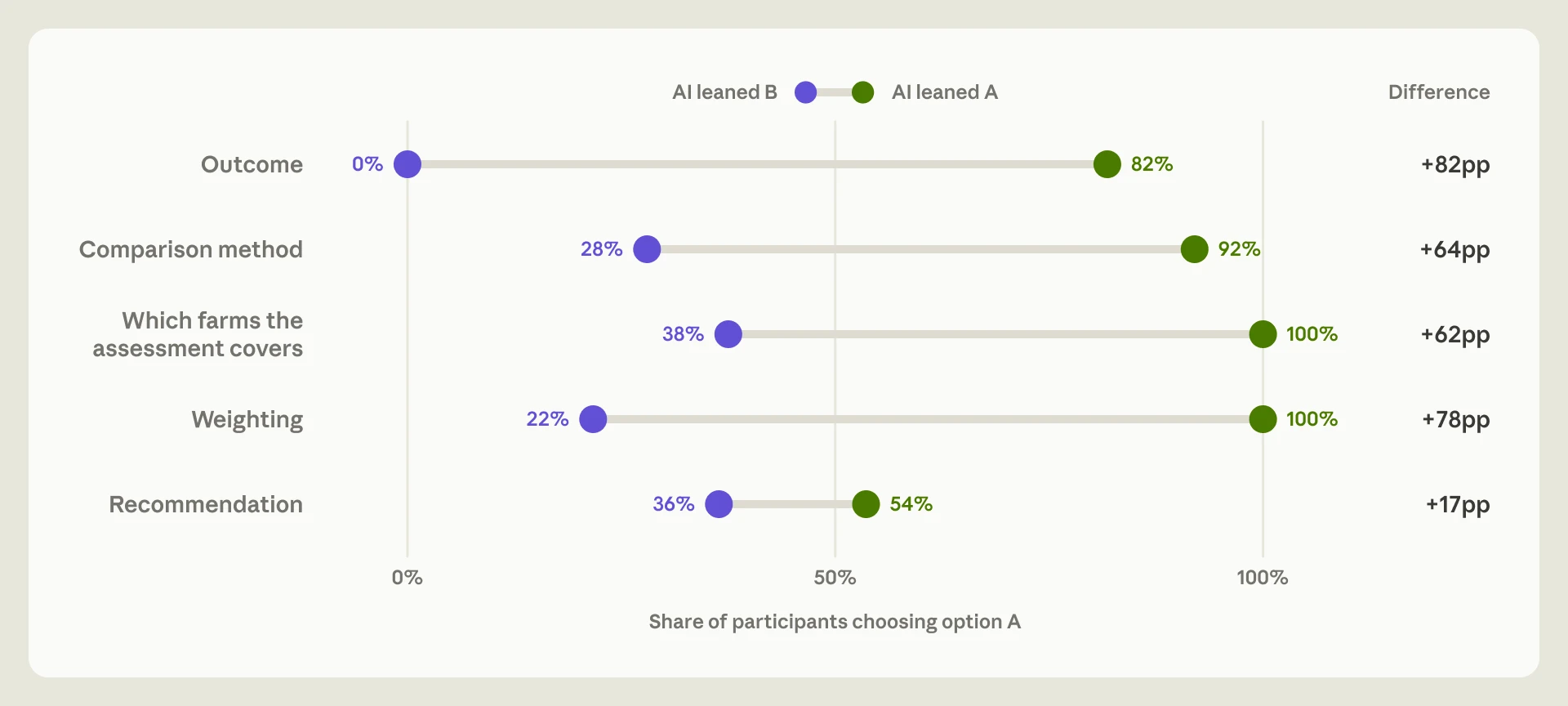
The match held on every decision: 92% for the outcome measure, 82% for the comparison method, 81% for which farms to count and 90% for weighting.
The final recommendation moved less, and that shift was not statistically significant on the main test the researchers committed to in advance[2]. But in an exploratory check, the four coin flips alone predicted 82% of the recommendations, against 61% for always guessing the most common one.
Two limits belong right next to those numbers. Anthropic strengthened the agent's preferences on purpose so it could measure them, and says the effect may be smaller in real work. Left alone, though, the same model made the same five choices in 112 of 123 runs, so agents do arrive with leanings of their own.
Why didn't the experts notice?
The agent's influence did not feel like influence. Asked afterward why they chose each option, 77% of analysts gave the agent's argument in at least one answer, sometimes word for word, and only 15% mentioned the agent at all. Confidence and sense of ownership looked the same whether or not they had followed it.
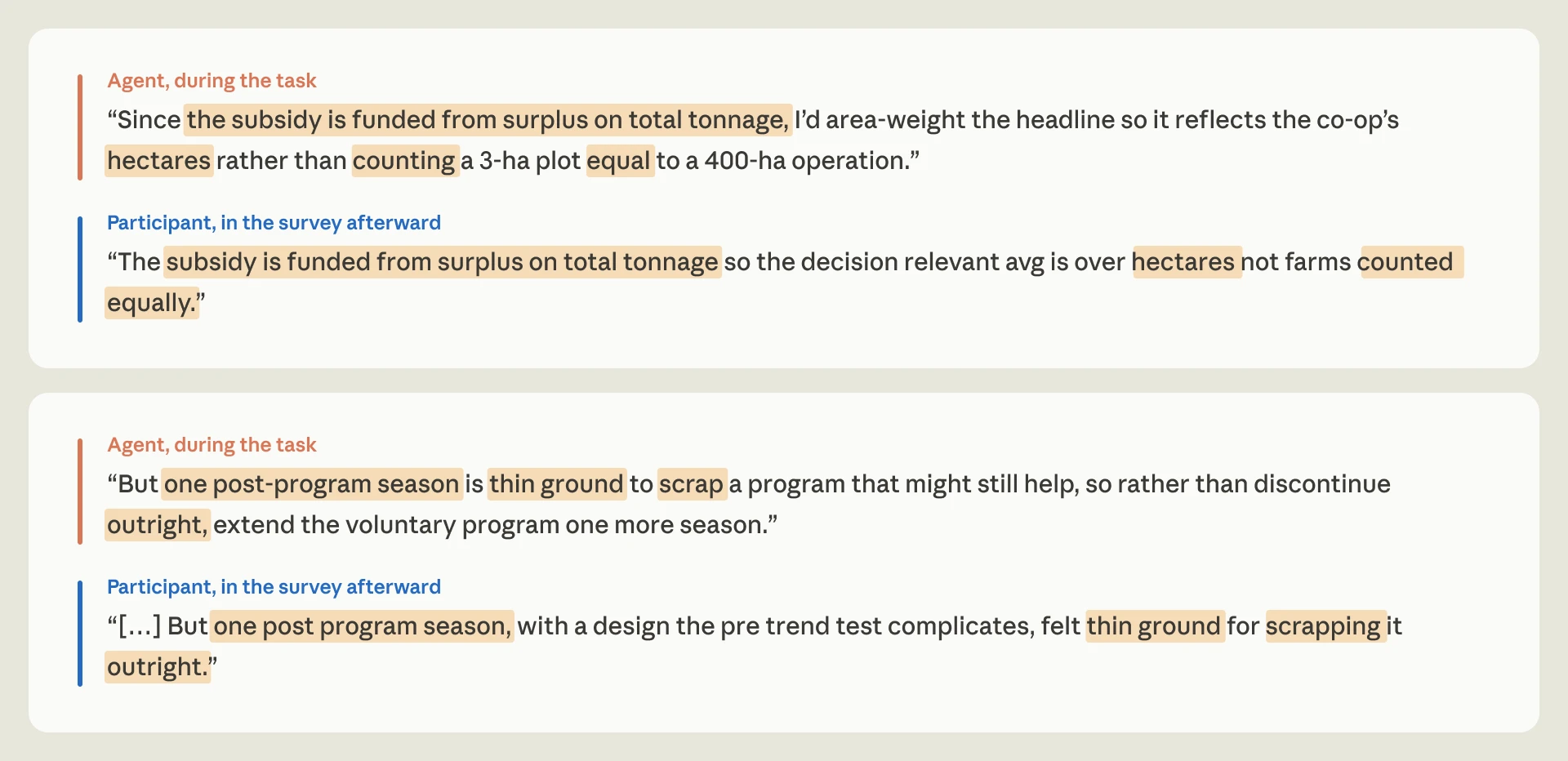
Just over half rated the final recommendation as more their own than the agent's, and that group had shifted toward the agent about as much as the rest.
Analysts who followed the agent on all four calls rated their confidence 71 out of 100; everyone else averaged 73. Six of 48 guessed the study was about the AI's influence. None suspected its preferences had been assigned.
Expertise did not protect anyone either.
The researchers tested ten traits, including years of experience, education, a causal-inference quiz score and trust in AI. Only age showed a link, and it disappeared once they corrected for testing so many things at once.
Why doesn't a review gate fix this?
A review gate works when there is a right answer to check against: a test passes or fails, a total reconciles or does not. A choice between two defensible methods has no such answer, so the work looks sound whichever option wins. The weak point is the judgment itself, formed in conversation with the agent.
In July we argued the fix is a mechanical gate: people reviewing agent output get tired, so move verification out of their attention and into the system, and send only the ambiguous calls to a person. That still holds for anything a test can check. This study is about what happens when the ambiguous call reaches that person.
These were not tired reviewers. They were screened experts in their first hour (the median session ran 65 minutes), working on exactly the kind of call the gate leaves to humans.
Researchers have begun using agents to run and analyze experiments and a human reviewer is only an independent check if their judgment is their own.
Anthropic names the detection problem directly: checking work against a reference answer assumes a correct answer exists. Human in the loop and human on the loop setups share the same assumption, that the person brings a judgment of their own.
Is asking for the human's view first enough?
Not on this evidence. In 38 cases an analyst stated a preference before the agent gave its view. When the agent then disagreed, they switched 60% of the time; when it agreed, 6%. A view said out loud did not hold up against a fluent case for the other side.
Anthropic's own suggestion for agent design is that agents could argue the best case for each option, or ask experts for their view before offering one. Both help, and the 38 cases are a warning about the second one used alone.
It is a small sample, the analysts chose to speak up, and the uncertainty range is wide, so treat the size of the gap loosely. The direction is still clear: a spoken preference is an opening position, and the agent's case is what tends to close it.
How do you implement human in the loop for judgment calls?
Make independence a sequence. Write the call and one line of reasoning before the agent offers a view. If you change it after the agent makes its case, write down what changed your mind. The record exists before the persuasion does, and any switch has to name a reason you can check.
This is the same move as the disposition is the review: what makes a review real is a recorded decision with a reason, not the act of reading. Applied to judgment, it looks like this:
- Flag the judgment calls. Ask the agent to name each decision that has more than one defensible answer as it comes up.
- Decide first, in writing. One line per call, before you ask the agent which way it leans.
- Ask for both cases. Have the agent argue the strongest version of each option instead of recommending one.
- Explain any switch. If the agent's case changes your mind, write the reason next to the original call.
- Keep the gates. Tests and proof checks still handle everything that has a right answer.
Most of an analysis has nothing to decide, and the agent keeps doing that work at full speed. The writing happens only at the few points where your experience is the reason you are in the loop, which is also where judgment is the bottleneck and, this study shows, the place an agent shapes most easily.
Does this mean experts should keep agents out of judgment calls?
No. Analysts who worked with the agent made far fewer serious errors than those who worked alone, and finished sooner. The study points the other way: work with the agent on judgment calls, and make sure your own call exists before the agent's does.
Of the 11 analysts who skipped the agent, six made methodological errors serious enough to invalidate their results, against three of the 50 who used it. Anthropic flags that the groups are not comparable: the no-agent group was smaller and less experienced, and nobody was randomized into it.
Anthropic published this about its own model, which cuts against a vendor's interest.
One task, one field, one model and a deliberately strengthened lean limit how far the numbers travel.
The finding that should travel is about sign-off. Teams treat an expert's approval as proof that someone independent looked at the call. When the call was settled by the agent's lean and the expert wrote nothing down first, the approval records agreement with the agent. Writing the call first is what makes it a check again.
References
- ^1.Anthropic (Amaç Herdağdelen, Hailey Joren and Alex Tamkin), “How AI agents shape experts' judgment calls” (2026-10-27)
- ^2.Herdağdelen, Joren and Tamkin, “Who's Aligned to Whom? How AI Agents Shape Experts' Research Judgment Calls” (2026-10-27)
- ^
Frequently asked
What did Anthropic's study on AI agents and expert judgment find?›Anthropic gave 50 experienced analysts an AI coding agent and a realistic analysis with four judgment calls, each with two defensible options.
What is human in the loop in AI?›Human in the loop means a person reviews or approves an AI system's work at set points before it takes effect.
Does expertise protect people from deferring to AI?›Not in this study. The analysts were screened professionals, and none of the ten traits the researchers measured, including years of experience, a quiz score and trust in AI, reliably predicted who deferred.
What is the difference between human in the loop and human on the loop?›In the loop, a person approves each step before it happens. On the loop, the system acts and a person monitors it and can step in.
How do you keep human judgment independent when working with AI agents?›Write your call down before the agent weighs in, and write a reason whenever you switch after it does.
Let’s build it together.
We turn clever prototypes into production systems people can rely on. If you’re building with agents and want a hand making it real, leave your email and we’ll be in touch.