The AI Productivity Paradox Isn't a Paradox
This week the internet decided AI has a productivity paradox. Everyone adopted the tools; the output numbers barely moved. Silicon Valley Product Group named it outright, Forbes asked where the extra capacity went, Business Insider declared a "great coding reset."[3] All circling the same puzzle.
The puzzle dissolves the moment you look at where AI is actually used. Two large measurements landed this year, and read together they say the modest number is not a mystery. It is the signature of the tool working exactly as designed.
Is the AI productivity paradox real?
The gap is real; the "paradox" is a framing mistake. Google's new ATLAS study, the largest measurement of AI use at work so far, shows adoption that is broad but shallow: AI reaches most jobs while touching a small share of the tasks inside any one of them. A modest aggregate gain is what that shape produces.
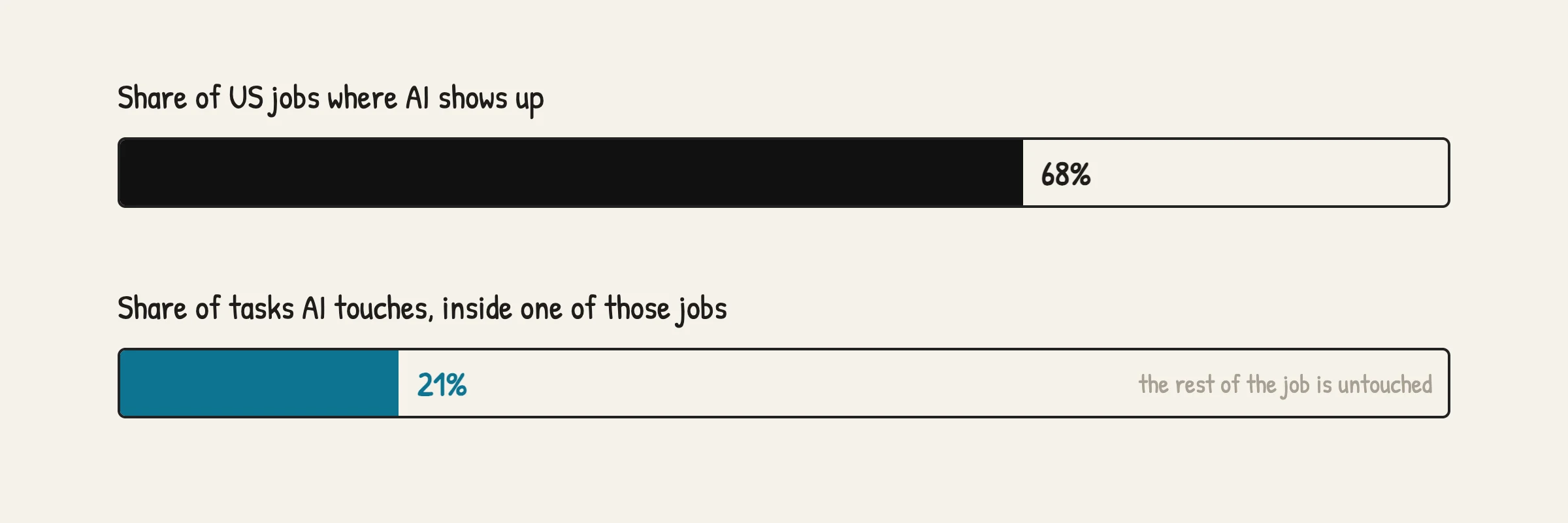
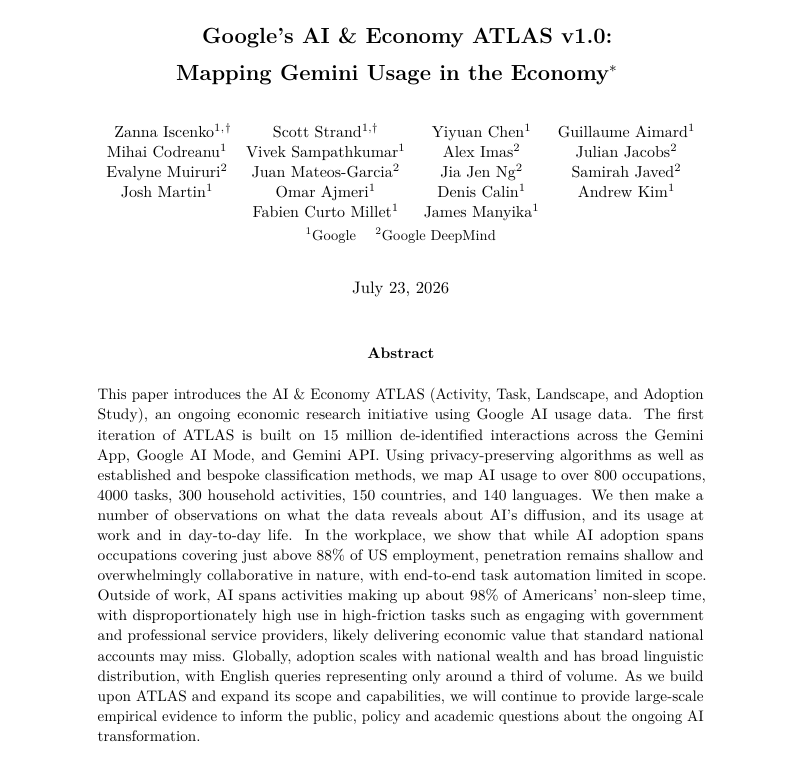
ATLAS (a Google and DeepMind research effort published July 23) mapped 14,653,926 de-identified Gemini conversations onto 800+ occupations and 4,000 work tasks.[1] AI usage appears in 68% of occupations, and those occupations cover 88.4% of US employment. So far, so revolutionary.
Then the number that reframes everything.
AI has reached 68% of occupations globally yet it covers only a median of 21% of the constituent tasks within those occupations.
Two-thirds of jobs use it; about a fifth of the work inside them is where it lands. (The 21% median is among occupations with meaningful usage; 29% show none.) And end-to-end automation, the model finishing a task with no human, is under 10% of the hard-thinking conversations.[1]
How much does AI actually increase developer productivity?
Just under 8%, at the median, measured across 400+ companies by the engineering-intelligence firm DX: and that is with 93% of developers using AI and usage up 65%. Most organizations land between 5% and 15%. DX's own title for the finding: "more modest than expected."[2]
Put the two studies together and the paradox evaporates. Near-universal adoption and a modest aggregate gain are not in tension. They are the same fact seen from two angles: a tool used on a minority of tasks produces a small average lift.
Why don't AI coding tools make teams dramatically faster?
Because writing code was never the whole job, and generation was rarely the bottleneck. The 8% is not spread evenly across the work: it is the average of real, large wins on a handful of tasks and roughly zero on everything else. Averaging a scalpel across a whole body of work gives you a small number and hides the cut.
ATLAS even tells you which tasks the scalpel finds. The hard thinking work (what researchers call non-routine cognitive tasks: hypothesis testing, design, analysis) makes up about 35% of professional tasks in the economy, yet draws nearly 65% of work-related AI use.[1]
People reach for AI on the thinking, not the paperwork.
That is the opposite of the "AI automates the boring stuff" story, and it is why the gains are judgment-shaped, not volume-shaped.
This is the thesis we keep arriving at from every direction: generation was never the bottleneck. Deciding what to build, integrating, reviewing, verifying, owning the outcome: those are the slow parts, and they are precisely where the human stays load-bearing. AI is fastest at the part that was never the constraint.
Will AI replace programmers?
The data points the other way. A tool that concentrates on assisting judgment-heavy tasks, and completes work end-to-end less than 10% of the time, is amplifying jobs rather than swallowing them. The role shifts toward what the model cannot finish alone, which is where a developer's leverage was already moving.
One honest caveat on scope: ATLAS measures Gemini interactions, one vendor's view, and interaction counts are not a full audit of the economy. The exact percentages are Gemini-shaped.
But the direction matches the independent, randomized-trial evidence on developers and AI, and it matches what DX measured in shipped output. Three different instruments, one shape.
What should teams measure instead of AI adoption?
Output, where AI actually moves it. "93% of our engineers use AI" got mistaken for "we should be 93% faster," and those were never the same quantity. Adoption is measured in people; impact happens in tasks. Grading a task-level assistant like a workforce multiplier is the entire so-called paradox.
The actionable version:
- Find the tasks where AI genuinely lifts throughput (usually the well-scoped cognitive ones) and instrument those, not the org-wide average.
- Invest where the cut is deep. A scalpel that reliably improves a fifth of the work is a genuinely valuable tool; aim it deliberately, the way the person closest to the problem would.
- Retire the flat-multiplier expectation. The disappointment was manufactured by the metric, not the machine.
And keep the both-sides honesty: 8% is not nothing. At a 500-engineer company, a gain in that range is dozens of engineers' worth of output with no new headcount. The error was never in the tool's value. It was in expecting a bulldozer and calling the scalpel broken.
The AI productivity paradox is 14.6 million interactions and 400 companies telling you what the manifesto said from the start: the machine is good at generating, generation was never the bottleneck, and the value still lives where the judgment is. Measure that, invest there, and the number stops being a disappointment and starts being a map.
References
- ^1.Google and Google DeepMind, “Google's AI & Economy ATLAS v1.0: Mapping Gemini Usage in the Economy” (July 23, 2026)
- ^
- ^
Frequently asked
How much does AI actually increase developer productivity?›Less than the hype, and more than the cynics say. ' That is not a 10x revolution, but at a 500-engineer company a 10% gain is the output of roughly 50 extra engineers.
Is the AI productivity paradox real?›The gap between near-universal adoption and modest aggregate gains is real; calling it a paradox is the mistake.
Will AI replace programmers?›The data points the other way. Google's ATLAS found AI is used most for non-routine cognitive work (about 65% of work interactions) and least for full end-to-end automation (under 10%).
Why don't AI coding tools make teams dramatically faster?›Because writing code was never the whole job, and generation was rarely the bottleneck.
What should teams measure instead of AI adoption?›Output and outcomes, not usage. 93% adoption tells you nothing about value; shipped throughput, cycle time, and quality do.
Let’s build it together.
We turn clever prototypes into production systems people can rely on. If you’re building with agents and want a hand making it real, leave your email and we’ll be in touch.