How to Make a Vibe Coded App Production-Ready Without Starting Over
Your team vibe coded something, and it works. Maybe it is an internal tool, maybe it is the first version of a product. People use it in a demo and it does the job.
Then it touches real client data, or a partner sends a security questionnaire, and nobody can say yes to shipping it. This post is about that exact spot, and what the next step actually is.
What did the biggest vibe coding event ever actually produce?
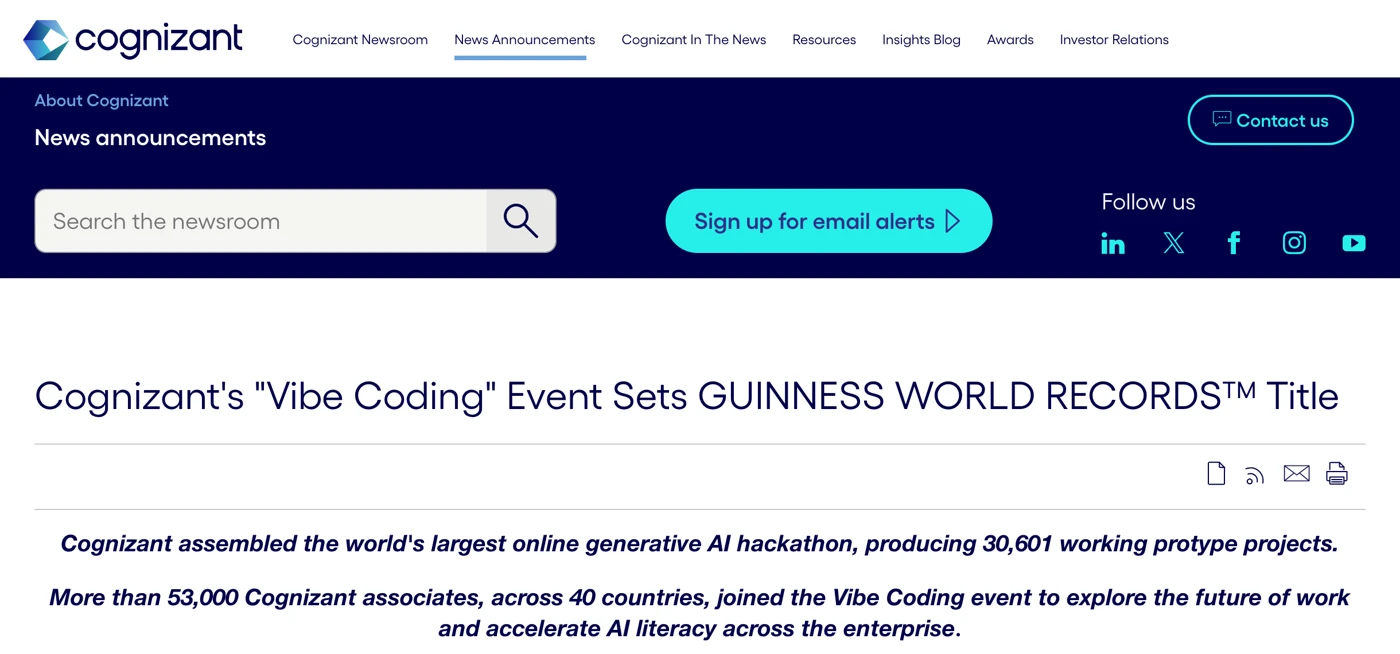
In August 2025, Cognizant ran the largest online generative AI hackathon on record, confirmed by a Guinness World Records adjudicator. Over ten days, 53,199 employees in 40 countries built with vibe coding tools and submitted 30,601 ideas and working prototypes. It is the clearest large-scale picture of what vibe coding produces.[1]
Participants came from HR, sales, finance, legal and marketing, not only engineering. Many built their first application that week. That part is real, and it is good news for anyone who has ever waited a year for software.
What happened after the prototypes?
Two months later, Cognizant packaged the event as a service for other companies. The offer includes a multi-agent system, built for the event, that scores prototypes "for accuracy, risk, business relevance and readiness."[2] The most successful vibe coding event ever ended with a pile of prototypes and a triage problem.
Read the release closely and the stopping point is stated plainly. The service helps business teams turn "ideas into prototypes that engineering can deliver more rapidly." The prototype is the output. Getting it into production is somebody else's next job.
Why are vibe coding services and productizing different jobs?
Vibe coding services help you make more working prototypes faster. Productizing takes one prototype you already have and makes it safe, shippable and maintainable with real data and real users. The first job ends at "it works." The second job starts there, and it asks different questions of the same code.
The timing makes the split easy to see. Twelve days after Cognizant launched its service, a data scientist at Capgemini's AI Lab published a piece titled "From prototypes to production: Is vibe coding ready?"[3] His answer was about people and process, not tools.
Though AI can accelerate some steps, production ultimately depends on people and processes, not just technology.
That matches what we see in the work. Vibe coding is tuned for the demo: the happy path, one user, the data you typed in yourself.
Productizing is tuned for Tuesday a month from now, when two people edit the same record, someone pastes a script into a form field, and a customer asks where their data lives. We wrote about that shift in how the prototype-to-production gap is a judgment call.
What does productizing a vibe coded app involve?
Productizing a vibe coded app means reading what exists, sorting each part into keep, harden or replace, and then closing the gaps in the order the risk demands. The idea and the screens usually survive. The data layer, the logins and the way the app ships usually do not, because demos never tested them.
In practice the work runs in the order below. Each step is small on its own. Together they are the difference between a tool your team likes and a tool your business can trust.
- Read before touching. Find where the data lives, where the keys are, and what is reachable from the open internet.
- Close what was left open. Move secrets and permission checks to the server, and turn off anything public that was never meant to be.
- Make the data trustworthy. Separate each person's records, add backups, and give the schema room to change.
- Build a real shipping path. One repeatable way to release a change and undo it.
- Name the exposure. List which laws and contracts apply to the data inside, and check that list with counsel.
The second step is the one a security audit of an AI-built app spends most of its time on, and it is where the scariest findings usually live.
Do you need to rebuild a vibe coded app from scratch?
Usually not. The product decisions inside a working app are the expensive part to rediscover, and the vibe coded version already contains them. What normally gets replaced is the plumbing underneath: the data layer, the logins and permission checks, and the path to production. Starting over throws away the part that was right.
Rebuilding feels safer because it is familiar. It also resets the clock on everything your team learned by using the thing. The screens people already know how to use, the fields they asked for, the steps they skip: that is weeks of product thinking, and it is sitting in the app right now.
The vibe coded app is the best requirements document your company has ever written.
Why internal tools are not low stakes
A lot of this work is on internal tools, not customer-facing products. A lean team builds its own software instead of buying it, which is a smart move. But the data in those tools is often the most sensitive in the building: client records, financials, deal terms.
One company we worked with had vibe coded three internal tools: an investment-scoring app, a portfolio tracker and a CRM. All three worked, and the team relied on them. None could be deployed, because each held sensitive data and nobody could answer the security and compliance questions that came with it.
Their own summary was the honest one: they did not know what they did not know.
The security firm RedAccess reviewed more than 380,000 publicly reachable assets built on vibe coding platforms. Roughly 5,000 looked corporate, and more than 2,000 of those held sensitive corporate, operational or personal data.[4]
We covered what that means for buyers in our post on technical due diligence for AI-built software. "Internal" describes who uses the tool, not how much it can leak.
Who should productize your vibe coded app?
Look for someone whose job is making an existing app trustworthy, not generating more of it. The work is small, senior and judgment-heavy: reading unfamiliar code, deciding what to keep, and knowing which risks matter for your data. Scale and headcount help with the first job and do little for this one.
The market has caught up to this need. Alongside the firms selling more vibe coding, a set of smaller shops now sells audit, cleanup and rescue for AI-built apps. That is a healthy sign. It also means the label on the service tells you less than the questions you ask.
Four questions sort the field quickly:
- Do they read before they rewrite? A good first week produces a map of your app, not a new repo.
- Do they treat your product decisions as the asset? The answer to "should we start over?" should rarely be yes.
- Do they name compliance exposure without playing lawyer? They should flag it and send you to counsel.
- Do you come out able to run it? You should understand what changed and why, well enough to keep building.
Our own answer to that last question shapes how we work: you stay in the work the whole way through, alongside us and the AI agents doing the heavy lifting. The app was yours when you built it, and it should still feel like yours when it ships.
If you are not sure where your app stands yet, start with the five-part readiness check in our production readiness guide. It will tell you which of the rows above are already fine.
Vibe coding got you something real, faster than anyone could have a few years ago. The next step is not more of it. It is taking the thing you built and making it something you can ship, trust and keep growing.
References
- ^1.Cognizant (PR Newswire), “Cognizant's "Vibe Coding" Event Sets GUINNESS WORLD RECORDS Title” (August 21, 2025)
- ^2.Cognizant (PR Newswire), “Introducing the Cognizant Enterprise Vibe Coding Blueprint: Services to Help Clients Accelerate AI-First Transformation” (October 17, 2025)
- ^3.Jonathan Aston, Capgemini, “From prototypes to production: Is vibe coding ready?” (October 29, 2025)
- ^4.The Hacker News, “What 2,000 Exposed Vibe-Coded Apps Reveal About the Limits of Most Security Stacks” (May 29, 2026)
Frequently asked
What does it mean to productize a vibe coded app?›It means turning something that runs into something a business can stand behind.
I vibe coded an app and it works. Why can't I just launch it?›Because working and shippable are different tests. Working means it did the right thing in the conditions you tried.
Do I need to rebuild a vibe coded app from scratch?›Usually not, and starting over is the most expensive reflex in this situation.
Who fixes a vibe coded app that cannot ship?›Someone whose job is productizing rather than generating more code.
Is vibe coding bad?›No. It is a fast, cheap way to prove an idea works, and that has real value.
Let’s build it together.
We turn clever prototypes into production systems people can rely on. If you’re building with agents and want a hand making it real, leave your email and we’ll be in touch.