Claude Code Pricing Is a Subscription for You and a Meter for Enterprise
There is a comfortable story going around about AI-assisted development getting cheap. Open-weight models keep taking share, the argument runs, so the price of a token is falling and the cost of building software falls with it.
The first half of that is measurably true. The second half depends entirely on something nobody in the conversation mentions, which is which contract you happen to be sitting under.
Is AI-assisted development actually getting cheaper?
Volume is moving. Price is not moving the same way, and there is now audited data separating the two.
Vercel publishes a monthly index of what actually runs through its AI Gateway. Open-weight models went from 11 percent of token volume in April 2026 to 29 percent in June and 36 percent in July.[1] That is a real, fast shift in what developers are routing. Then the same index reports where the money went.
Anthropic collected 65% of gateway spending on 30% of token volume, at 4.4 times the average price of every other lab's tokens.
That is the whole shape in one sentence. A third of the tokens, two thirds of the bill.
The investor Gavin Baker, who circulated the chart that kicked off this round of discussion, forecasts that the end state looks like this permanently: closed frontier tokens settling at 60 to 90 percent of economic value on only 15 to 25 percent of tokens.[5] Vercel's July numbers are already inside that band.
Worth being careful with one figure that is travelling fast. Baker's post cites open weights hitting 62 percent of token share, and that number is real, but it is a single day reading from a live chart on 22 August, not a monthly index. Vercel's audited series still ends at 36 percent for July. Treat 62 as a leading indicator and 36 as the trend.
He is also right about the part everyone skips: "Nothing about open-source AI inference is 'free.'" An open-weight token costs roughly the same compute to produce as a frontier one. The difference is who pays for it, and where it shows up on your bill.
One gateway is one gateway, so it is worth checking whether this is a Vercel quirk. It is not. OpenRouter, a completely separate routing platform, publishes its own rankings, and over the thirty days to 26 August open-weight models carried roughly 62 percent of tokens there while Anthropic sat near 7 percent of volume.
Different platform, different measurement window, different classification rules, and the same split: volume has moved and spend has not followed it.
Why does the same model cost different amounts?
Because price is a property of the contract, not of the model. Anthropic publishes three separate economies for the same Claude Code work, and they are not tiers of one thing.
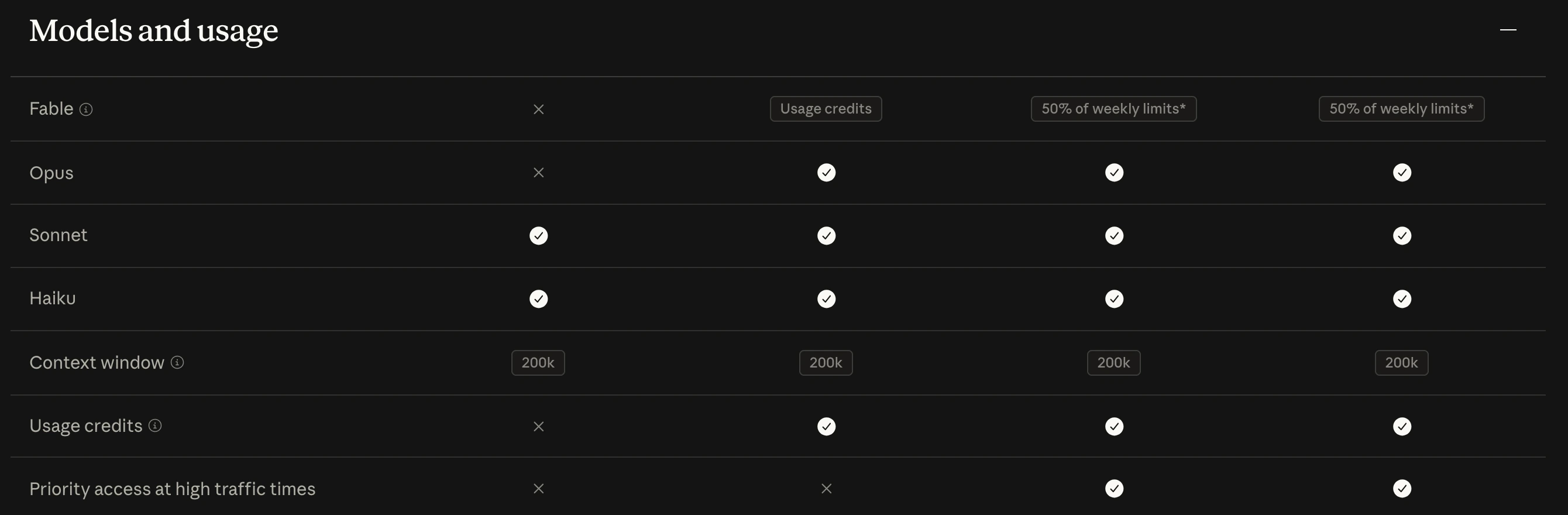
- Max. $100 a month for 5x, $200 for 20x. Fable 5 is "included as a standard part of your plan," usable "up to 50% of your weekly usage limits" at no extra cost.[3]
- Team. $25 per seat monthly for standard, $125 for premium. Premium seats get the same 50 percent treatment. Subscription quota, not metered billing, and the two tiers are not close: Anthropic rates standard seats at 1.25 times Pro's per-session usage and premium seats at 6.25 times.
- Enterprise, on current usage-based plans, is the one that changes the picture.
The seat fee only covers access to the platform and doesn't include any usage. All usage across Claude, Claude Code, and Cowork is billed separately at standard API rates. There are no per-seat usage limits and no included token allowance.
Read those two paragraphs next to each other. One developer gets a flat monthly number and a weekly allowance. The developer beside them, doing identical work under a different contract, gets a meter.
What does $200 a month actually buy?
Not as much as it feels like, and the arithmetic is worth doing out loud rather than taking on faith.
Claude Fable 5 on the API is $10 per million input tokens and $50 per million output.[4]
So a $200 monthly spend, if you were paying list, works out to roughly 4 million output tokens. Spent entirely on input instead, about 20 million. Split evenly, call it 6 or 7 million tokens all in.
There is a detail here that makes the point sharper than it first looks. When a Pro or Team Standard seat buys usage credits to reach Fable 5, Anthropic bills those credits at standard API rates.[3] The same $10 and $50. Not a discounted subscriber rate, the list rate.
The subsidy lives entirely in the allowance. Outside it, you are an API customer with a nicer login.
Now think about what an agentic coding session actually consumes. A single long run across a large repository, reading files, holding context, revising, re-reading, can burn through a meaningful fraction of that in an afternoon. Run a few of those a week and the monthly subscription is not a discount on the metered price. It is a different economy with a different unit, and who absorbs that variance is the question the whole metered-versus-included split turns on.
None of which is a complaint. The terms are published plainly and the subsidy is a reasonable way to grow a developer base. The problem is what it does to the conversation.
The people writing about how cheap AI coding has become are overwhelmingly sitting on subsidised individual seats. They are not wrong about what they experience. They simply have no exposure to the price they are describing, because their bill does not move when token prices do. We made the same argument when OpenAI cut prices 80% and most agent bills did not move.
What happens when you hit the allowance?
Not what the headline number suggests, and the detail matters if you are budgeting around a Max seat.
The 50 percent figure is not extra quota bolted on top. Anthropic is explicit that Fable 5 "draws from your plan's regular weekly usage limits and uses them faster than other Claude models," and its own FAQ answers the obvious follow-up bluntly: asked whether the allowance means 50 percent more weekly limit, the answer is no.[3] You can spend up to half your week on the expensive model.
You cannot spend more week.
Nor does hitting the ceiling stop you. You either switch to another model and carry on inside the plan, or you keep going on Fable 5 with usage credits, which are billed at standard API rates.[3] That second option is the interesting one, because it is the moment a subscription seat becomes a metered one, mid-week, with no change of tool and no new decision.
And these terms move. The 50 percent allowance is itself the settled state after a promotion that ended on 19 July 2026, and Pro seats lost included access when it did.[3]
Any cost analysis written before that date now describes a plan that does not exist. Date your own numbers, and re-check them before you lean on them.
Does the subscription give you the same product?
Not exactly, and this part surprised me.
Anthropic's plan comparison lists a 200k context window on the consumer plans. Claude Fable 5 on the API is a 1M context model.[4] For long-horizon agentic work on a large codebase, context is not a specification detail. It is most of what determines whether the agent can hold the problem at all.
So the seat changes what you get, not only what you pay. Two developers on the same tool, same model name, working from different-sized windows.
What should you actually do with this?
Three things, and none of them is a vendor recommendation.
- Ask which economy each seat is in before you extrapolate. One person's experience of AI coding cost is not a forecast of your team's bill. That goes for anyone posting from a subsidised seat, and it goes for the numbers in this post.
- Price the metered case even if you are not on it. If your team moved to usage-based billing tomorrow, what would last month have cost at list rates? That is the number that scales with headcount, and usage drift is how it grows without anyone deciding to spend more.
- Watch value share, not volume share. Open weights taking token share is real and will keep going, and the 6x price gap is genuinely capturable if you pay the production tax. It still tells you little about what you will pay here, because the work routed to frontier models is the work people pay a premium for, and that premium is holding at 4.4 times.
The model name on your invoice is the least interesting line on it. The contract above it decides almost everything, and it is the part nobody argues about on the internet.
References
Frequently asked
How much does Claude Code cost?›It depends on the plan, and the plans are not variations on one price.
Is a Claude Code subscription cheaper than the API?›For heavy use, dramatically, and the arithmetic is easy to check.
Do enterprises pay API rates for Claude Code?›On current usage-based Enterprise plans, yes. Anthropic's documentation says the seat fee covers access only and that all usage is billed separately at standard API rates, with no per-seat usage limits and no included token allowance.
Is open-source AI making development cheaper?›It is moving volume, which is not the same as moving price. 4 times the average price of every other lab's tokens.
Does a Claude subscription give the same model as the API?›Not identically. Anthropic's plan comparison lists a 200k context window on the consumer plans, while Claude Fable 5 on the API is a 1M context model.
Let’s build it together.
We turn clever prototypes into production systems people can rely on. If you’re building with agents and want a hand making it real, leave your email and we’ll be in touch.