Why Good Roadmaps Get Fuzzier Further Out
Hard truth: Nobody actually knows what specific features will ship in Q4. The world will change. Customers will teach you something. A competitor will move. The team will learn things that make the Q4 list obsolete. And yet the roadmap commits to it with the same level of granularity as next sprint, because that's what the template asked for.
This is how most roadmaps get built, and it's why most roadmaps are treated as fiction by everyone in the room.
The fake-precision problem
The instinct is to make roadmaps legible by making them specific. If the team can see exactly what's coming, they can plan, coordinate, prepare. Specificity feels like rigor.
But specificity that outruns certainty isn't rigor. It's theater. The further you extend it into the future, the more it degrades. Not because the format is wrong, but because the information simply isn't there yet. You're filling in the squares because the template has squares, not because you actually know.
The alternative most teams swing to is worse. After getting burned a few times on specific commitments, they go vague across the board. "Improve onboarding." "Enterprise readiness." "Performance work." This feels safer but teaches nobody anything. The engineer three weeks out needs more than that. The customer success lead planning renewals needs more than that. You've traded one kind of uselessness for another.
The fix isn't to pick a single level of specificity and apply it everywhere. It's to match specificity to certainty, which means the roadmap has to look different at different distances.
Specificity should decay
Here's the core idea: as you look further out in time, the roadmap should lose resolution, not keep it.
Near-term, you know a lot. Which features are in flight. Who's building what. What the acceptance criteria look like. The roadmap can and should be granular. It's actionable for the people actually shipping.
Mid-term, you know less. You know the shape of the work, the major bets, the problems you're investing in. You don't know every feature yet, and pretending you do is the mistake. The roadmap should describe categories of work, not line items.
Long-term, you know the least. You know where the product is trying to go, what bets you're making about the market and the customer, what kind of company you're becoming. The roadmap shouldn't describe features or even categories at this horizon. It should describe direction.
Three horizons, three different kinds of specificity, each matched to how much you actually know. Call it a logarithmic roadmap: the resolution drops off with distance, on purpose.
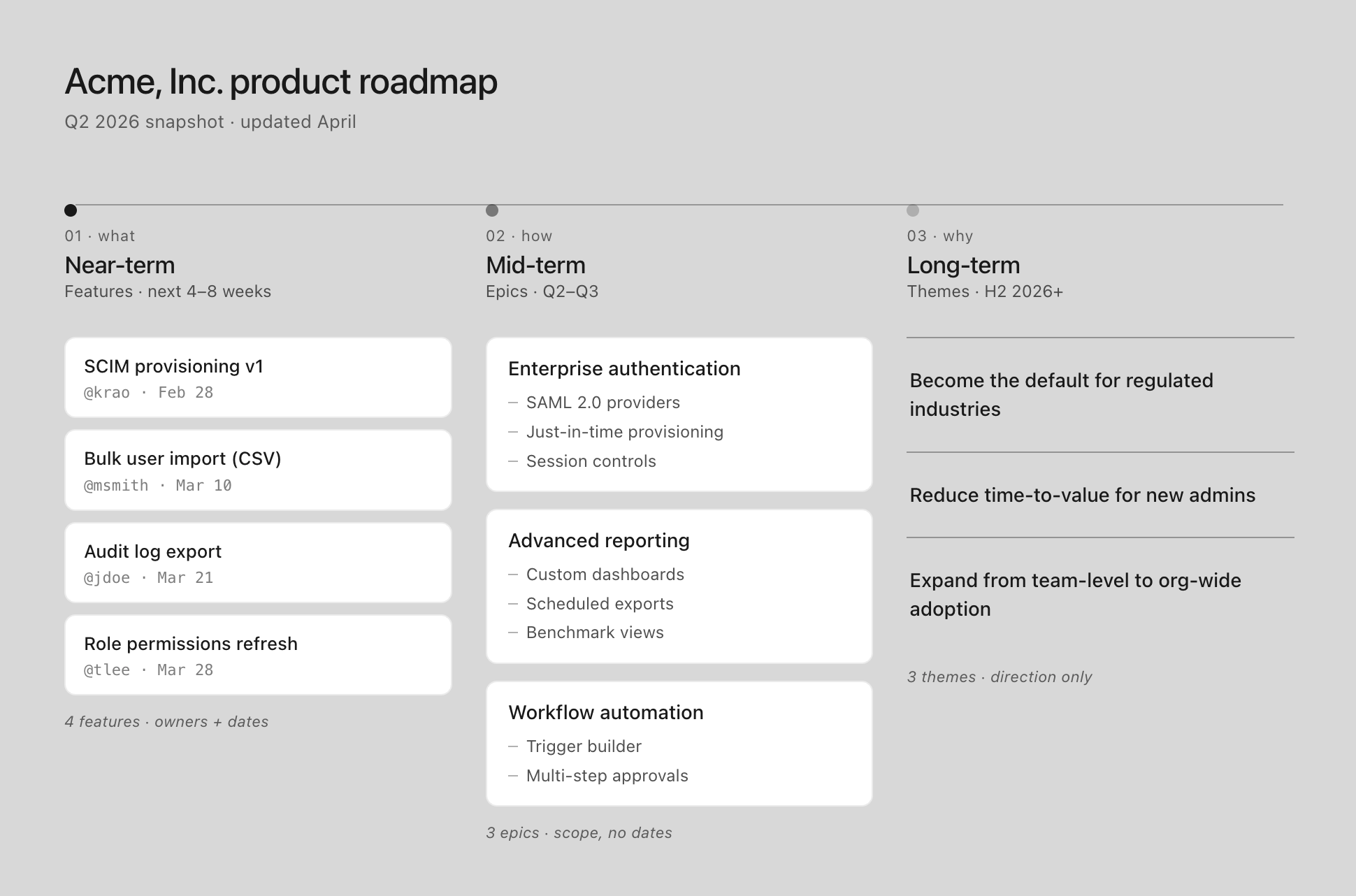
The three layers
Each horizon also has a different primary consumer, and the format should serve that consumer.
Near-term: Features (the what)
The near-term layer is for the people building. It's list-like, concrete, and measurable. Specific features, specific deliverables, specific acceptance criteria. Owners attached. Dates attached, with appropriate uncertainty baked in.
If someone asks "what are we shipping in the next six to eight weeks," the answer lives here. The test for anything at this horizon: can an engineer or designer start work on it tomorrow without asking three clarifying questions? If not, it's not ready to be near-term yet.
This is where the product brief earns its keep. Each near-term item should trace back to a brief that captures the thinking: who it's for, what success looks like, and why it matters.
Mid-term: Epics (the how)
The mid-term layer describes the shape of the work, one level up from features. Epics, categories, major initiatives, each with a small set of bullets that sketch what it contains without committing to every detail.
"Enterprise Authentication" is an epic. Under it, bullets like "SSO with Microsoft Entra," "SCIM provisioning," "Audit log export." You're not committing to every acceptance criterion for SSO yet. You're committing to the fact that you're investing in enterprise auth, here's what's in scope, and here's roughly what it contains.
The mid-term layer is for cross-functional alignment. Sales can tell prospects "we're working toward enterprise SSO." Support can start getting ready. Engineering leads can think about the architecture. Nobody is building from this layer yet, but everyone can orient around it.
Long-term: Themes (the why)
The long-term layer is directional. Themes, not epics. "Improving collaboration for distributed teams." "Increasing conversion from trial to paid." "Becoming the default for regulated industries." These aren't to-do items. They're statements of intent.
The long-term layer is for leadership, the board, and customers trying to decide whether you're the right partner for the next three years. They don't need to know what ships in March. They need to understand where the product is heading and whether that direction matches their future.
This is the layer that usually gets skipped or written too vaguely to be useful. A theme that reads "improving the product" is not a theme. It's a placeholder. A good theme has enough edge that it could not be chosen. "Improving onboarding retention for SMB accounts" is a real theme because you could instead be improving expansion revenue for enterprise, and the choice matters.
The trap: horizons that don't talk to each other
Having three layers isn't enough on its own. The most common failure mode is that the layers get built by different people, at different times, and nothing converts between them.
Themes sit on an executive slide and never touch the backlog. Epics show up in planning without ever being tied to a theme. Features appear in the near-term list without anyone asking which epic they belong to. Three horizons, three disconnected artifacts, and the roadmap is a collage instead of a system.
The fix is a graduation mechanic: a recurring ritual where work moves from theme to epic to feature, and nothing moves without being questioned.
Every quarter (or whatever cadence fits), you ask three questions of the roadmap:
- Which themes are ready to resolve into epics? If a theme has been sitting on the board for a year without ever producing an epic, it's either not a real theme or not a real priority. Say so.
- Which epics are ready to resolve into features? An epic moves to the near-term layer when you've done enough discovery to actually scope it. If it's been in the mid-term for multiple cycles without ever being ready, that's a signal.
- Which features still belong? Don't auto-promote. The near-term list should be recommitted to, not inherited. Things that seemed obvious three months ago look different after three months of learning.
Graduation isn't automatic. It's a decision. That decision is where the roadmap stays honest.
The tactical toolkit
With the structure in place, here are the practices that keep it working.
Don't mix horizons on the same view
A single chart that tries to show features, epics, and themes at once will either look cluttered or quietly force everything down to one level of specificity. Give each horizon its own view, and make the relationship between them explicit: this feature belongs to this epic, this epic belongs to this theme.
Write themes with enough edge to be rejectable
If a theme could describe any product at any company, it's too vague. The test is whether someone could reasonably argue for a different theme. "Improve retention" fails the test. "Improve retention for the first 30 days of SMB accounts" passes. You could instead prioritize enterprise expansion, and reasonable people could disagree about which to pursue.
Resist the urge to decorate themes with features
When a theme lives too long on the slide, the temptation is to stuff it with example features to make it feel more real. Don't. If the features are real, promote them to the epic or near-term layer. If they're illustrative, drop them. A theme cluttered with tentative features is a theme losing its function.
Timebox the near-term tightly
The near-term layer should cover a short enough window that the team can actually commit to it. Six to eight weeks, a quarter at the outside. If the near-term layer starts stretching to cover six months, specificity drifts out of alignment with certainty and the fake-precision problem comes back.
Re-commit to themes on a longer cadence
Themes shouldn't change quarterly. That's not direction, that's thrashing. But they shouldn't be immortal either. An annual (or semi-annual) review where leadership explicitly re-commits to or retires each theme is what keeps the long-term layer honest. Calcified themes are as bad as missing ones.
Warning signs
The roadmap is drifting out of calibration when:
- Q4 items look as specific as Q1 items. Fake precision. The template is driving the roadmap instead of the other way around.
- The same theme has been on the slide for 18 months without producing an epic. Calcification. Either the theme isn't a priority or it's not actually a theme, it's a wish.
- Features are appearing in the near-term list without a clear epic or theme above them. The roadmap is being built bottom-up only. That works for a while, but it means long-term direction is emergent rather than chosen.
- Leadership can't state the long-term themes from memory. If the people meant to be steering by direction can't recite the direction, the long-term layer isn't doing its job.
- Engineering is re-planning the mid-term layer every sprint. The epics aren't stable enough, or they were written too specifically too early.
The honest roadmap
The hardest thing about roadmapping isn't picking what to build. It's being honest about what you know and don't know at each distance. A roadmap that promises the same level of detail two years out as two weeks out is lying, and everyone in the room knows it, which is why nobody takes the out-years seriously in the first place.
A roadmap that decays in specificity as it extends into the future is doing the opposite. It says: here's what we're committed to now, here's the shape of where we're heading next, here's the direction we're heading overall. Three different kinds of commitment, each matched to what's actually knowable.
That's the roadmap people can plan against. Not because it pretends to know more than it does, but because it doesn't.
Frequently asked
What is a logarithmic roadmap?›A logarithmic roadmap is a planning approach where resolution drops off with distance on purpose.
How specific should a product roadmap be?›Specificity should match certainty. Near-term items (next 6-8 weeks) should be concrete enough that an engineer can start work without asking clarifying questions.
What are roadmap horizons?›Roadmap horizons are three layers of planning at different levels of resolution.
How do you prevent fake precision in roadmaps?›Fake precision happens when roadmaps extend specific feature commitments into timeframes where that level of detail isn't knowable.
What is a roadmap graduation mechanic?›A graduation mechanic is a recurring ritual where work moves from theme to epic to feature across roadmap horizons.
Let’s build it together.
We turn clever prototypes into production systems people can rely on. If you’re building with agents and want a hand making it real, leave your email and we’ll be in touch.