What are Chladni patterns, and what they taught us about building products
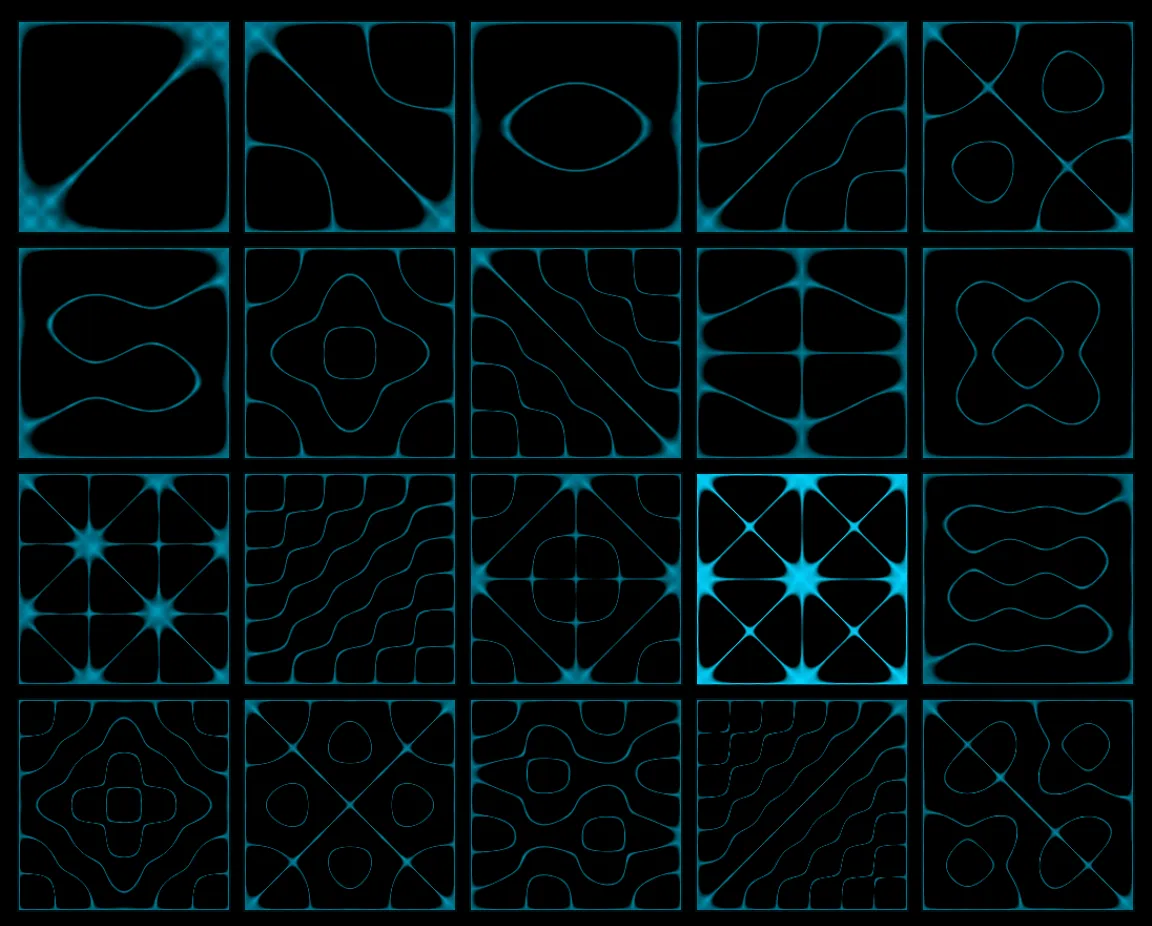
Run a violin bow along the edge of a metal plate sprinkled with fine sand, and the grains don't scatter. They skitter, leap, and settle into a precise geometric figure: concentric rings, a radiating star, a lattice of curving lines. Change the pitch and the whole thing reorganizes into something new. Same plate, same sand.
These are Chladni patterns. They're one of the most striking demonstrations in physics, and we ended up putting 20 of them on our homepage. This is the physics behind them, and the connection we didn't see coming.
How do Chladni patterns form?
Chladni patterns form because a vibrating plate doesn't move uniformly. Some regions oscillate up and down, while thin lines between them stay perfectly still. Those motionless lines are called nodal lines. Sand bounces off the moving areas and comes to rest along the still ones, making the invisible vibration visible.
In 1787, a German physicist named Ernst Chladni ran a bow across the edge of a brass plate covered in sand. The plate sang, the sand moved, and instead of scattering randomly the grains lined up along the nodal lines. He cataloged dozens of these figures in a book on the theory of sound, and they've carried his name ever since. (Robert Hooke had noticed something similar with flour on a glass plate a century earlier, but Chladni was the one who turned it into a method.)
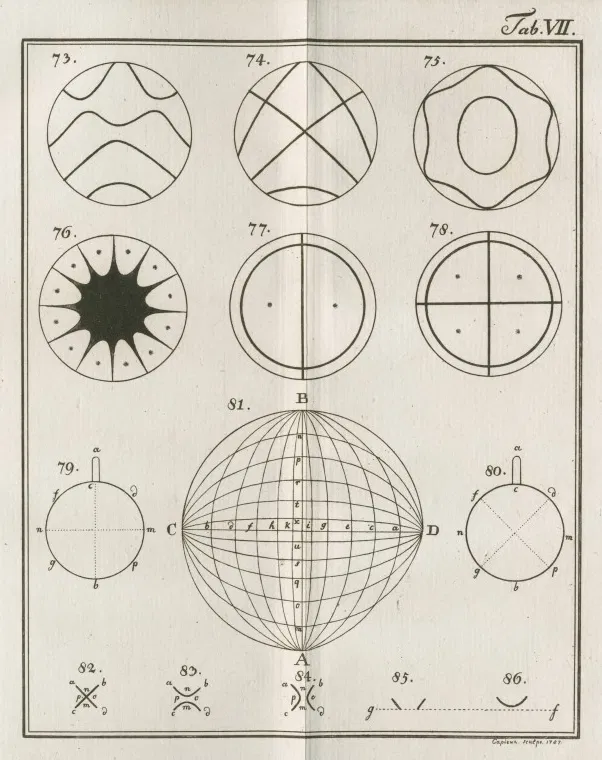
The demonstration was a sensation. When Chladni performed it for Napoleon in 1809, the emperor was impressed enough to fund a prize for anyone who could explain the patterns mathematically. The mathematician Sophie Germain spent years on the problem and won it. What captivated all of them was the same thing that captivates anyone who sees it today: an invisible force, made visible. You couldn't see the vibration. But you could see exactly what it created.
Why does changing the frequency change the pattern?
Each frequency excites a different vibration mode of the plate, and every mode has its own arrangement of nodal lines. A low frequency might produce a simple cross. A higher one produces an intricate grid. The plate doesn't change. The sand doesn't change. Only the frequency changes, and that rewrites the structure completely.
This is the part that feels like magic. The same physical object holds an enormous library of latent patterns inside it, and frequency is the key that selects which one appears. Hit the wrong frequency and you get noise, sand jittering everywhere with no coherence. Hit a resonant one and a clean, ordered figure snaps into place. Nobody draws it. The physics finds it.
The modern study of this has a name: cymatics, the visualization of sound through matter. But the core idea is older and simpler. A surface vibrating at the right frequency organizes whatever sits on it into a standing wave pattern, and the sand just reveals where the stillness lives.
What is the Chladni equation?
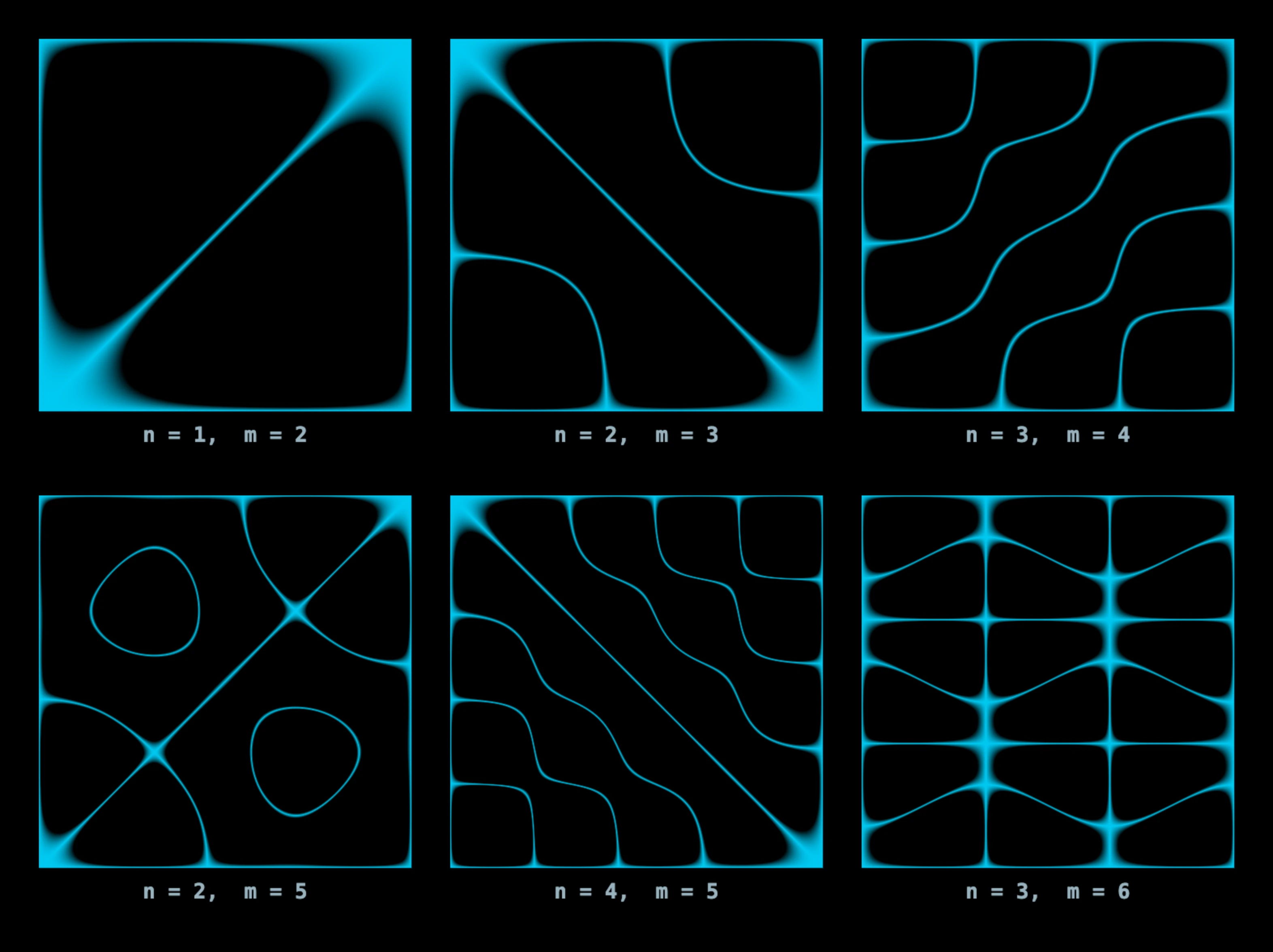
For an idealized square plate, the nodal pattern can be modeled by a single equation that adds two perpendicular sine waves:
f(x,y) = a·sin(nπx)·sin(mπy) + b·sin(mπx)·sin(nπy)
The two whole numbers, n and m, are the mode: they set how many half-waves run across the plate in each direction. The coefficients a and b control how the two waves mix. Where the equation crosses zero, the plate is still, and that's where the sand would settle. Feed in different values of n and m and the formula draws a completely different figure.
The 20 cells on our homepage come from exactly this. One formula, 20 sets of parameters, 20 patterns. The variety doesn't come from 20 different equations. It comes from one equation and 20 different inputs.
What Chladni patterns taught us about building products
We put these images on our homepage because they were beautiful. They felt right for a company called Generative Labs: elegant math, on-brand aesthetic, twenty variations clearly part of one family.
It wasn't until we sat with the physics that the rest clicked. We had picked, without meaning to, an almost literal picture of everything we believe about building products with AI.
Resonance creates structure. Volume doesn't. A Chladni pattern only forms at the right frequency. Vibrate the plate randomly and you get noise. This is the difference between building with intention and building with volume. More AI output doesn't produce better products. More generated code doesn't produce better architecture. But the right combination of domain expertise, product thinking, and agentic capability produces something none of those ingredients could produce alone. Structure emerges.
The input determines everything. Same equation, different parameters, fundamentally different pattern. We wrote in our manifesto that AI amplifies your direction, right or wrong. The Chladni equation is a literal demonstration. It doesn't care which parameters you give it. It renders whatever those parameters dictate, with total fidelity. Your input isn't just important. It's the only thing that matters.
The patterns aren't designed. They emerge. Nobody draws a Chladni figure. Nobody tells the sand where to settle. The structure arises from the interaction between a set of rules (physics) and an input (frequency). That's what building with AI feels like at its best. You set the parameters (the product brief, the architecture, the domain constraints) and work alongside agents that execute with speed and breadth. The human provides the frequency. The agents are the medium. The product is the pattern, and it's something neither could have produced alone. We've come to think of that as layered collaboration between humans and agents.
The invisible, made visible. Chladni's real genius wasn't the vibration. It was the sand. The standing waves and nodal lines existed whether anyone could see them or not. He just found a way to reveal them. The patterns that produce great products (clear product thinking, domain expertise in the room, intentional direction before agents execute) have always been what separates good products from bad. AI didn't invent them. It made them visible. When the feedback loop is fast enough, you can see the difference between intentional direction and vague prompting almost immediately. The good patterns reveal themselves. So do the bad ones.
One formula, infinite variety
There's one last thing about the grid that resonates.
Twenty patterns, one equation. The variety doesn't come from complexity. It comes from input. Each cell is the same simple math with different parameters, and the range of what that simple math produces is extraordinary.
That's what a way of working should feel like. Not a complex framework that prescribes every step. A clear set of principles that produces a different outcome for every engagement, because the input is different every time. Your domain. Your market. Your expertise.
The equation is the way of working. Your expertise is the frequency. The product is the pattern that nobody else could have produced, because nobody else has your particular combination of inputs.
Frequently asked
What are Chladni patterns?›Chladni patterns are the geometric shapes that sand forms on a vibrating metal plate.
How do Chladni patterns form?›A vibrating plate doesn't move uniformly. Some regions oscillate up and down while thin lines between them stay perfectly still.
Why do different frequencies create different Chladni patterns?›Each frequency excites a different vibration mode of the plate, and each mode has its own arrangement of nodal lines.
What are nodal lines?›Nodal lines are the places on a vibrating surface where the motion cancels out to zero.
Who discovered Chladni patterns?›Ernst Chladni, a German physicist often called the father of acoustics, demonstrated the patterns in 1787 by drawing a violin bow across a sand-covered metal plate.
What is the Chladni equation?›For an idealized square plate, the nodal pattern can be modeled by a single equation that adds two perpendicular sine waves: f(x,y) = a·sin(nπx)·sin(mπy) + b·sin(mπx)·sin(nπy).
Let’s build it together.
We turn clever prototypes into production systems people can rely on. If you’re building with agents and want a hand making it real, leave your email and we’ll be in touch.